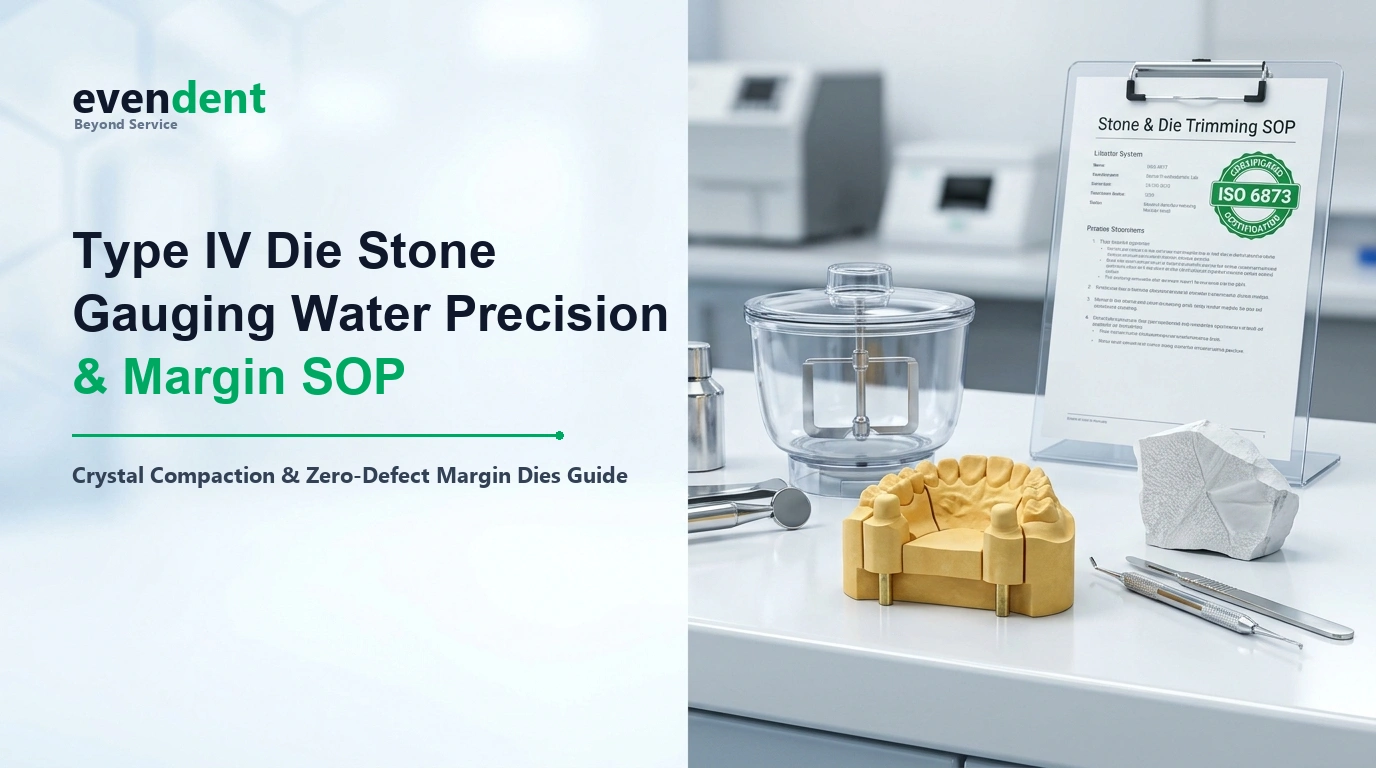

In fixed prosthodontics, implant master cast fabrication, and digital CAD/CAM milling workflows, the physical fidelity of the master die dictates the marginal fit of the final restoration. A gap of merely 30 μm between a zirconia crown margin and the prepared tooth structure can lead to cement washout, recurrent micro-leakage, and eventual secondary caries.
Under ISO 6873 (Dental gypsum products), Type IV High-Strength, Low-Expansion Dental Die Stone represents the gold standard for master models. However, achieving its promised mechanical hardness (>60 MPa) and microscopic linear stability (<0.08%) requires strict adherence to gauging water chemistry and vacuum mixing protocols.
1. Crystal Morphology: Alpha-Hemihydrate vs. Modified Alpha Die Stone
The extraordinary physical performance of Type IV stone stems from its unique calcinated crystal structure:
+------------------------------------------------------------------------+
|                 GYPSUM CRYSTALLIZATION COMPACTNESS                     |
+------------------------------------------------------------------------+
| Plaster of Paris (Beta-Hemihydrate, Type II):                          |
| Irregular, spongy, porous flakes -> Requires 50 mL water per 100g      |
| ===> High internal porosity; Low crushing strength (~12 MPa)           |
|                                                                        |
| Type III Dental Stone (Standard Alpha-Hemihydrate):                    |
| Prismatic, needle-like crystals -> Requires 28-30 mL water per 100g     |
| ===> Medium density (~35 MPa); Ideal for diagnostic study casts        |
|                                                                        |
| EvenDent Type IV Die Stone (Modified Cuboidal Alpha-Hemihydrate):      |
| Dense, non-porous cuboidal prisms -> Requires ONLY 20-22 mL water      |
| ===> Ultra-compact crystalline matrix; >65 MPa crushing strength        |
+------------------------------------------------------------------------+
The Gauging Water Mechanism
Gypsum requires only 18.6 mL of water per 100g of hemihydrate powder for stoichiometric chemical conversion into calcium sulfate dihydrate. Any water added beyond this theoretical minimum serves solely as “gauging water” to lubricate the powder particles for pouring:
* In Type II plaster, 30+ mL of excess gauging water leaves massive micro-capillaries upon evaporation.
* In EvenDent Type IV Die Stone, advanced dispersing agents allow efficient particle sliding with just 1.5 to 3.5 mL of excess water, creating an almost void-free solid crystal matrix.


2. The ±1 mL Sensitivity: Impact on Expansion and Crushing Strength
In the dental laboratory, technicians occasionally adjust water by eye to achieve faster pouring. This practice severely compromises model accuracy:
| Gauging Water Ratio (per 100g Powder) | 2-Hour Compressive Strength | 24-Hour Linear Setting Expansion | Surface Hardness (Rockwell M) | Clinical Outcome |
|---|---|---|---|---|
| 19 mL / 100g (Too Dry / Stiff) | 70 MPa (Extremely hard) | 0.12% (Excessive expansion) | 90+ | Crown seats too tightly; binding |
| 20 – 22 mL / 100g (OPTIMAL) | > 65 MPa (Certified) | 0.06% – 0.08% (Precision) | 85 – 88 | Sub-20 μm passive fit (CAD/CAM ready) |
| 24 mL / 100g (Diluted / Watery) | 45 MPa (-30% strength loss) | 0.04% (Under-expanded) | 70 | Margins chip during blade trimming |
| 26 mL / 100g (Severe Error) | < 35 MPa (Fragile model) | < 0.02% (Shrinkage risk) | 58 | Dies fracture under articulator pressure |
3. Laboratory Standard Operating Procedure (SOP)
To guarantee consistent reproducibility across master dies:
- Digital Weighing: Always use a calibrated digital scale for stone powder and a graduated syringe or cylinder for distilled water. Tap water contains variable mineral ions (sulfates, chlorides) that unpredictably accelerate or retard setting time.
- Vacuum Mixing Protocol: Hand-spatulate powder and water for 15 seconds to wet all particles. Then place under a mechanical vacuum mixer (pressure: -0.8 to -0.9 bar) at 350 RPM for exactly 45 seconds. Vacuum mixing eliminates micro-bubbles that cause scanning artifacts on CAD/CAM laser digitizers.
- Vibration Pouring: Pour the mixed slurry onto the impression tray under mild vibration. Introduce stone from one heel of the arch in small increments, allowing the heavy slurry to displace air ahead of it across tooth preparations.
- Separation Timing: Allow the stone cast to set for a minimum of 45 to 60 minutes before removal from the impression. Premature separation causes margin fracture, as stone compressive strength is only 30% developed at 30 minutes.
4. Optical Scanability for CAD/CAM Desktop Scanners
Modern dental laboratories routinely digitize stone master dies using structured-light or blue-light desktop scanners:
* Glare-Free Matte Finish: Generic stones with high gloss or translucent mineral impurities cause optical refraction, requiring messy titanium dioxide scan sprays.
* High-Contrast Color Pigments: EvenDent Type IV Die Stone is formulated in high-contrast Golden Brown, Pastel Green, and Pearly Peach colors with specialized light-absorbing fillers, ensuring crisp scan point clouds with zero digital noise.

 English
 Español
 Português
 Français
 Italiano
 Deutsch
 Русский
 日本語
 한국어
 العربية