
In international medical device distribution, importing dental consumables requires rigorous regulatory and quality documentation. A general commercial invoice or broad conformity declaration is no longer sufficient; regional health authorities, customs border inspection agencies, and institutional hospital audit boards increasingly mandate a comprehensive, batch-specific Certificate of Analysis (COA) prior to cargo clearance.
Under ISO 13485:2016 quality management systems and EU CE MDR (Medical Device Regulation) standards, the COA serves as the legal scientific proof that a specific manufacturing lot meets all physical, chemical, and biological performance specifications before market release.
1. Anatomy of a Legally Compliant Dental Consumable COA
A compliant Certificate of Analysis must detail clear, verifiable batch testing data rather than generic promotional statements:
+------------------------------------------------------------------------+
|                  CORE STRUCTURE OF AN ISO 13485 COA                    |
+------------------------------------------------------------------------+
| 1. Product Identification: Trade Name, Catalog Ref (SKU), Model/Type   |
| 2. Manufacturing Traceability: Lot/Batch Number, Production & Expiry   |
| 3. Raw Material Pedigree: Polymer/Gypsum Grade, Ingot/Pouch Source     |
| 4. Test Matrix: Parameter, Test Method (ISO/ASTM), Standard vs. Actual |
| 5. Environmental Conditions: Test Temperature (°C), Humidity (% RH)   |
| 6. QA Release Sign-Off: QC Inspector Signature, QA Director Stamp      |
+------------------------------------------------------------------------+
Essential Traceability Identifiers
- Lot Number (Batch Code): Uniquely tied to specific production shifts, operator logs, and raw material synthesis batches.
- Shelf-Life Validation: Real-time and accelerated stability study data supporting the stated 2-year or 3-year expiration date.
- Harmonized ISO Test Standards: Each parameter must explicitly state the testing standard utilized (e.g., ISO 21563 for alginates, ISO 4823 for elastomeric impression materials, ISO 6873 for gypsum).
2. Product-Specific Testing Parameters and Acceptance Criteria
Different dental consumable categories undergo distinct laboratory testing protocols prior to lot sign-off:
| Product Line | Testing Parameter | Governed Standard | Acceptance Specification | Passing Actual Example |
|---|---|---|---|---|
| Dental Alginate | Total Working Time (23°C) | ISO 21563 | 1 min 30 sec – 2 min 00 sec | 1 min 45 sec [PASS] |
| Dental Alginate | Line Reproduction | ISO 21563 | 50 μm continuous line | 50 μm continuous [PASS] |
| Dental Alginate | Elastic Recovery | ISO 21563 | ≥ 95.0% | 97.8% [PASS] |
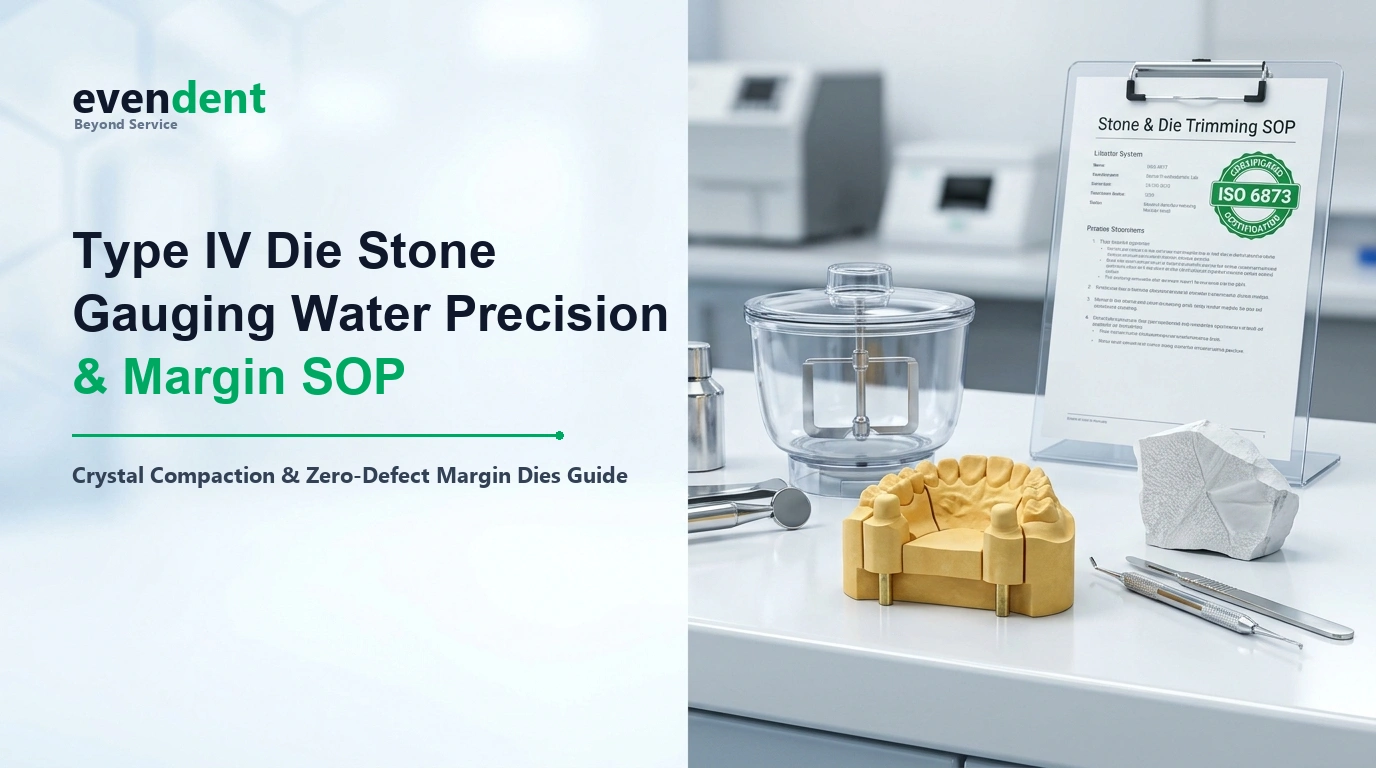
| Type IV Dental Stone | Water-to-Powder Ratio | ISO 6873 | 0.20 – 0.24 mL/g | 0.22 mL/g [PASS] |
| Type IV Dental Stone | Linear Setting Expansion (2h) | ISO 6873 | ≤ 0.10% | 0.08% [PASS] |
| Type IV Dental Stone | 24h Compressive Strength | ISO 6873 | ≥ 45.0 ext{ MPa} | 54.2 MPa [PASS] |
| VPS Impression Silicones | Linear Dimensional Change (24h) | ISO 4823 | ≤ 0.50% | 0.12% [PASS] |
| VPS Impression Silicones | Strain in Compression | ISO 4823 | 2.0% – 6.0% (Putty) | 3.4% [PASS] |
| Disposable Dental Bibs | Water Strike-Through Barrier | AATCC 127 | Zero leakage @ 50 cm hydrostatic head | 0 mL leakage [PASS] |
3. Retained Sample Archives and Defect Investigation Workflows
ISO 13485:2016 Section 7.5.3 mandates that medical device manufacturers maintain a physical retained sample library for every released production lot:
- Retention Period: Retained samples must be preserved under climate-controlled conditions (20°C–25°C, < 60% RH) for the entire stated shelf life plus a minimum of one additional year (typically 3 to 4 years total).
- Root Cause Analysis (CAPA): If an international distributor or clinician reports an anomaly (e.g., slow alginate gelation or premature silicone setting), QA engineers immediately pull the corresponding retained batch samples.
- Retest Protocol: The retained sample is tested under controlled laboratory conditions to determine whether the issue is a genuine formulation deviation or the result of extreme freight temperatures, improper warehouse humidity, or chairside procedural error.
4. International Regulatory Dossier Integration: FSC, CE MDR, and Customs Clearance
For B2B importers, the Certificate of Analysis does not stand alone; it forms the operational apex of the regulatory compliance file:
+-----------------------------------------------------------------------+
|                    GLOBAL COMPLIANCE DOSSIER HIERARCHY                |
+-----------------------------------------------------------------------+
|  Top Tier: Free Sale Certificate (FSC) & ISO 13485:2016 System Cert   |
|                                |                                      |
|  Middle Tier: CE Declaration of Conformity (DoC) & Technical File     |
|                                |                                      |
|  Operational Tier: Batch-Specific COA, MSDS/SDS & Packing List        |
+-----------------------------------------------------------------------+
- Customs Clearance Smoothness: Customs officials in the European Union, Middle East, and Latin America cross-reference the Lot Number printed on the shipping carton label directly against the Lot Number on the COA. Any discrepancy triggers immediate container quarantine.
- EvenDent Compliance Pack: Every commercial shipment includes an authenticated batch COA, Safety Data Sheet (MSDS) compliant with GHS Revision 8, and official Certificate of Free Sale (FSC) issued by national health authorities.
5. B2B Distributor Best Practices: Archive Management and Digital Traceability
To maintain clean regulatory standing and facilitate rapid product recalls if ever required:
- Digital Batch Matching: Record incoming lot numbers into your ERP/WMS inventory software upon warehouse receipt, matching them directly to customer delivery notes.
- Inspection Verification: Cross-verify that physical packaging labels bear matching lot codes, manufacturing dates, and expiration dates identical to the accompanying COA.
- Instant Document Access: EvenDent provides permanent cloud access to electronic COA archives for all past shipments, ensuring our distributor partners can retrieve audit documentation within minutes.
Related EvenDent Products & Guides:
– Products: alginate impression material universal type – full range in the Impression Materials category hub.
– Further Reading: importing dental consumables from China.

 English
 Español
 Português
 Français
 Italiano
 Deutsch
 Русский
 日本語
 한국어
 العربية