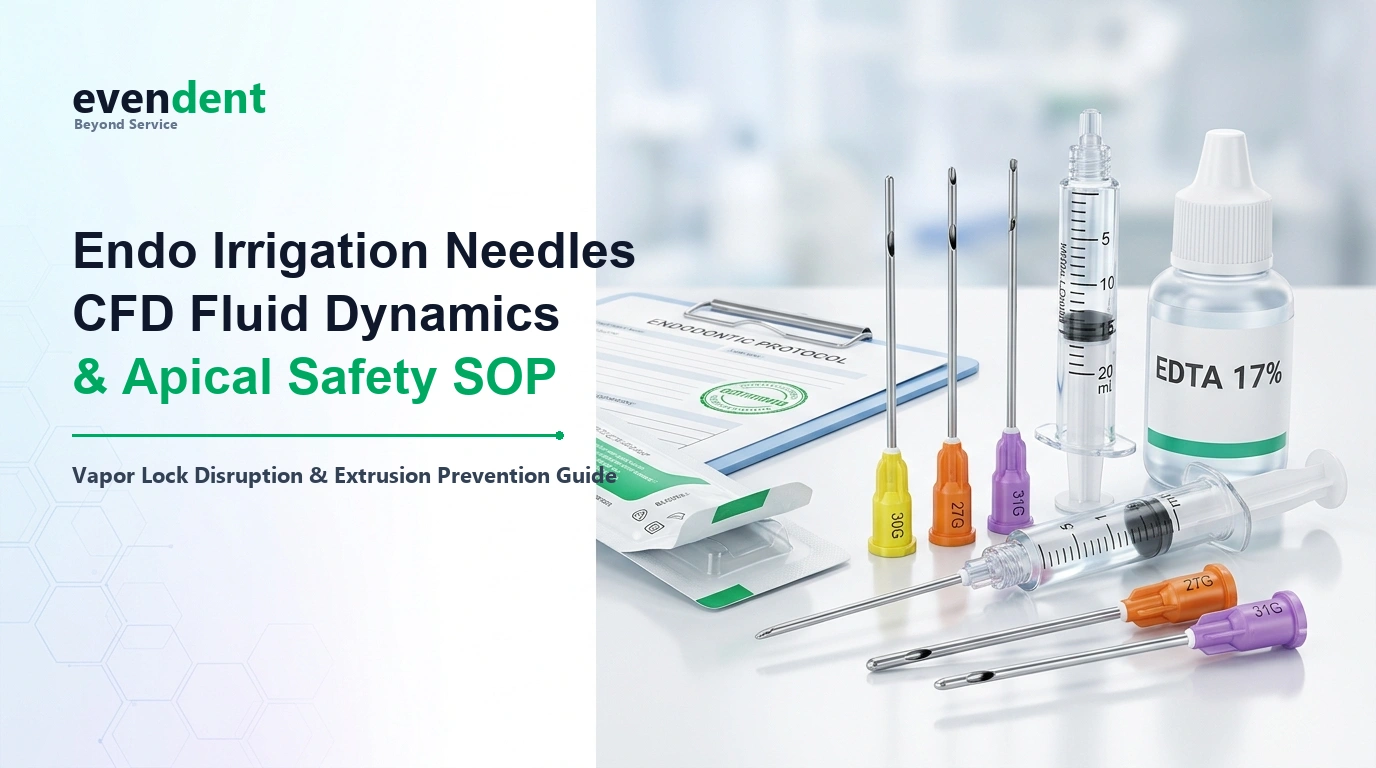

In modern endodontic therapy, mechanical instrumentation cleans only 50% to 60% of the root canal system. Intricate anatomical variations—including lateral canals, isthmuses, and apical deltas—can only be decontaminated through effective chemical irrigation using sodium hypochlorite (NaOCl) and ethylenediaminetetraacetic acid (EDTA).
However, delivering irrigants to the apical third presents a dangerous dual challenge: clinicians must disrupt the stagnant apical vapor lock while strictly avoiding periapical extrusion of caustic hypochlorite. Understanding the fluid dynamics of different needle tip architectures is crucial to achieving clinical disinfection without tissue damage.
1. The Physics of Apical Vapor Lock and Wall Shear Stress
During rotary canal preparation, organic tissue dissolution by NaOCl generates micro-bubbles of carbon dioxide and ammonia. In a closed-ended conical canal, physical capillary forces trap this gas in the apical 2 to 3 mm, creating a high-pressure vapor lock:
+------------------------------------------------------------------------+
|                   APICAL HYDRODYNAMIC FLOW PROFILES                    |
+------------------------------------------------------------------------+
| Open-Ended Flat Needle (High Extrusion Hazard):                        |
| Axial Jet Velocity: > 10 m/s                                           |
| Apical Extrusion Pressure: 25 - 40 kPa (Exceeds venous cap ~2.0 kPa)   |
| ===> Severe hypochlorite accident; Acute bone necrosis & hematoma      |
|                                                                        |
| EvenDent 30G Closed-End Side-Vented Needle (Gold Standard):            |
| Apex Configuration: Hemispherical closed tip                           |
| Lateral Port Velocity: Dynamic vortex jetting against canal wall       |
| Apical Pressure at Foramen: < 1.5 kPa (Completely safe buffer)         |
| ===> Complete vapor lock exchange with ZERO extrusion risk             |
+------------------------------------------------------------------------+
The Velocity Stagnation Zone
In open-ended needles, fluid velocity drops to zero immediately past the tip opening, creating a dead-water zone. Irrigant replacement occurs only 1 mm beyond the needle tip. To irrigate the apical terminus, clinicians are tempted to bind open-ended needles deep into the apex—a fatal error that causes immediate hydraulic blow-out through the apical foramen.


2. Tip Architecture: Side-Vented vs. Double Side-Vented vs. Multi-Vent
EvenDent manufactures medical-grade 304 stainless steel irrigation needles in three dedicated tip configurations:
| Needle Tip Architecture | Fluid Discharge Vector | Apical Pressure at WL – 1.5mm | Biofilm Wall Shear Stress | Recommended Preparation Taper |
|---|---|---|---|---|
| Single Side-Vented (Closed End) | Lateral 90° single jet | < 1.8 kPa (Safe) | Very High (Focused jet) | 0.04 or 0.06 taper (Size #25+) |
| Double Side-Vented (Staggered) | Opposing dual lateral jets | < 1.2 kPa (Ultra-Safe) | High (Balanced vortex) | 0.06 taper (Size #30+) |
| Multi-Vent Micro-Perforated | 360° circumferential spray | < 0.8 kPa (Minimal) | Medium (Gentle rinse) | Wide canals / Immature apices |
| Open-Ended Beveled (Traditional) | Direct axial forward jet | > 28 kPa (DANGEROUS) | Low on walls, High on apex | Contraindicated in modern endo |
3. Gauge Selection: 27G vs. 30G Flow Dynamics
The external diameter (OD) and internal lumen (ID) of the needle determine how deep it can penetrate without binding against prepared dentin:
- 27G Needle (OD: 0.41 mm): Fits comfortably in coronal and middle thirds; suitable for initial gross debris flushing. However, in small curved canals, it binds at WL – 5 mm, leaving the apical third uncleaned.
- 30G Needle (OD: 0.31 mm): Can passively negotiate curved roots down to working length minus 1.0 to 1.5 mm in any canal instrumented to a standard ISO #25 / 0.04 taper.
- High-Flow Thin-Wall (HTW) Engineering: EvenDent utilizes ultra-thin wall drawing technology, expanding the 30G internal lumen to 0.20 mm. This reduces extrusion resistance by 35%, allowing smooth, non-fatiguing hand dispensing while maintaining rigid burst pressure above 150 psi.
4. Safe Clinical Protocol for Endodontic Irrigation
- Verify Needle Binding: Prior to injecting NaOCl, gently insert the needle to the determined depth. Ensure the needle is completely loose and non-binding. If resistance is felt, withdraw 1 mm.
- Continuous Up-and-Down Oscillation: Maintain a rhythmic 2 to 3 mm vertical stroking motion during dispensing. This dynamic agitation sweeps spent debris coronally and prevents localized pressure accumulation.
- Low-Speed Dispensing Flow: Dispense irrigant at a controlled rate of 1 to 2 mL per minute. Rapid bolus injection spikes hydraulic pressure without improving cleaning efficiency.
- Luer-Lock Security: Always attach needles to threaded Luer-Lock syringes to eliminate the catastrophic hazard of the needle popping off under hydraulic pressure.



 English
 Español
 Português
 Français
 Italiano
 Deutsch
 Русский
 日本語
 한국어
 العربية