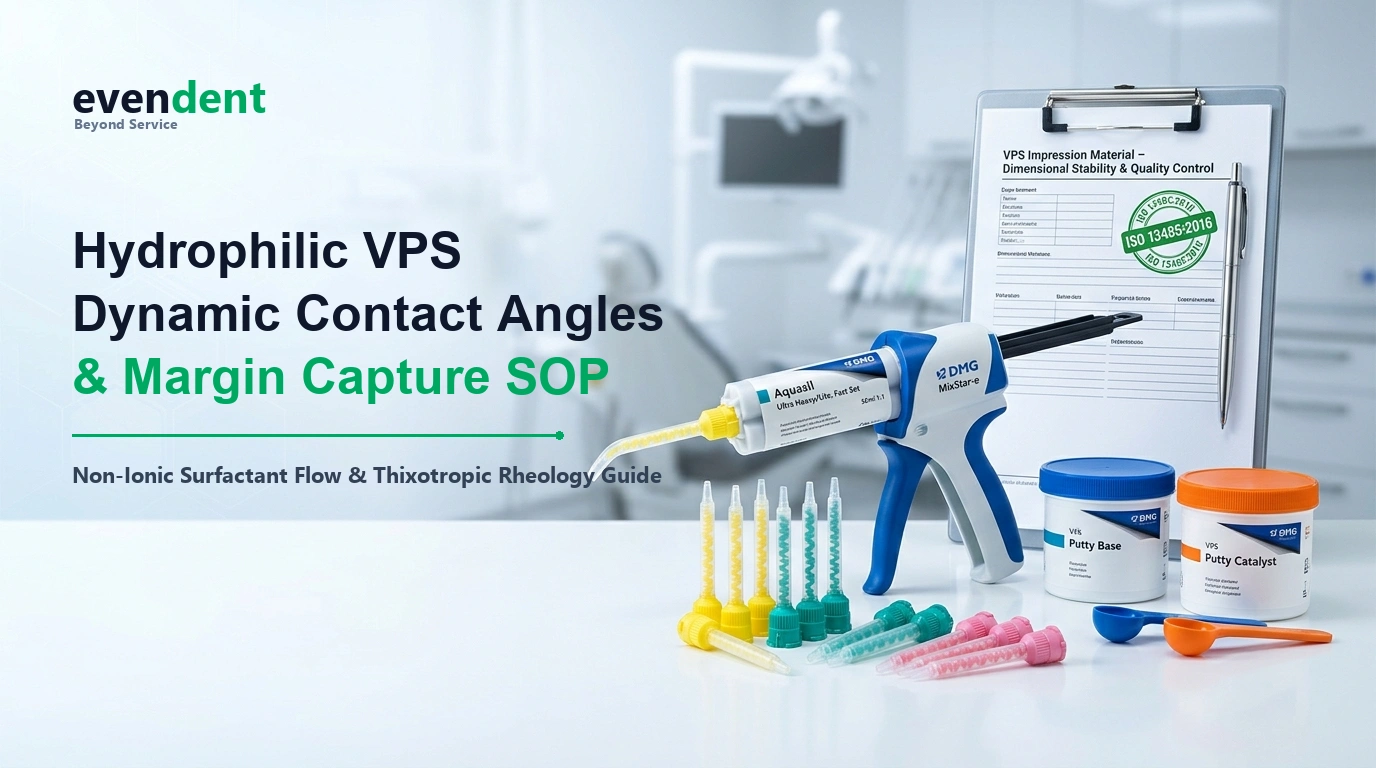

Addition silicone (Vinyl Polysiloxane or VPS) is celebrated for its exceptional dimensional stability, tear strength, and elastic recovery. However, pure polydimethylsiloxane polymers are inherently hydrophobic, presenting natural water contact angles exceeding 95 degrees. In the moist oral cavity—where teeth are coated with sulcular fluid, blood, and saliva—hydrophobic materials beading on wet surfaces produce marginal bubbles, roundings, and voids.
Modern Hydrophilic VPS Materials resolve this challenge by incorporating non-ionic surfactant additives that dynamically lower the liquid contact angle, ensuring crisp, subgingival finish line capture.
1. Surface Chemistry: Non-Ionic Surfactants and Dynamic Wetting
The fundamental physics of impression wetting is described by Young’s Equation, which relates interfacial surface tensions to contact angle (θ):
γSV = γSL + γLV cos θ
+------------------------------------------------------------------------+
|                     CONTACT ANGLE WETTING PROFILE                      |
+------------------------------------------------------------------------+
| Unmodified Generic Silicone: High Surface Tension                      |
| [ Tooth Prep ] ---> Water Droplet Beads (Angle > 90°)                  |
| ===> Silicone repelled by wet sulcus; creates voids and margin defects |
|                                                                        |
| Hydrophilic VPS: Surfactant-Modified                                   |
| [ Tooth Prep ] ---> Rapid Fluid Spread (Dynamic Angle < 20°)           |
| ===> Active displacement of moisture into micro-grooves and margins    |
+------------------------------------------------------------------------+
The Polyether-Siloxane Surfactant Mechanism
- Non-Ionic Fluorinated or Polyether-Modified Surfactants: These specialized surfactant molecules are blended throughout the VPS matrix.
- Surface Migration: When the uncured paste contacts moisture, the hydrophilic heads orient outward toward the aqueous film, dramatically reducing the surface tension of oral fluids.
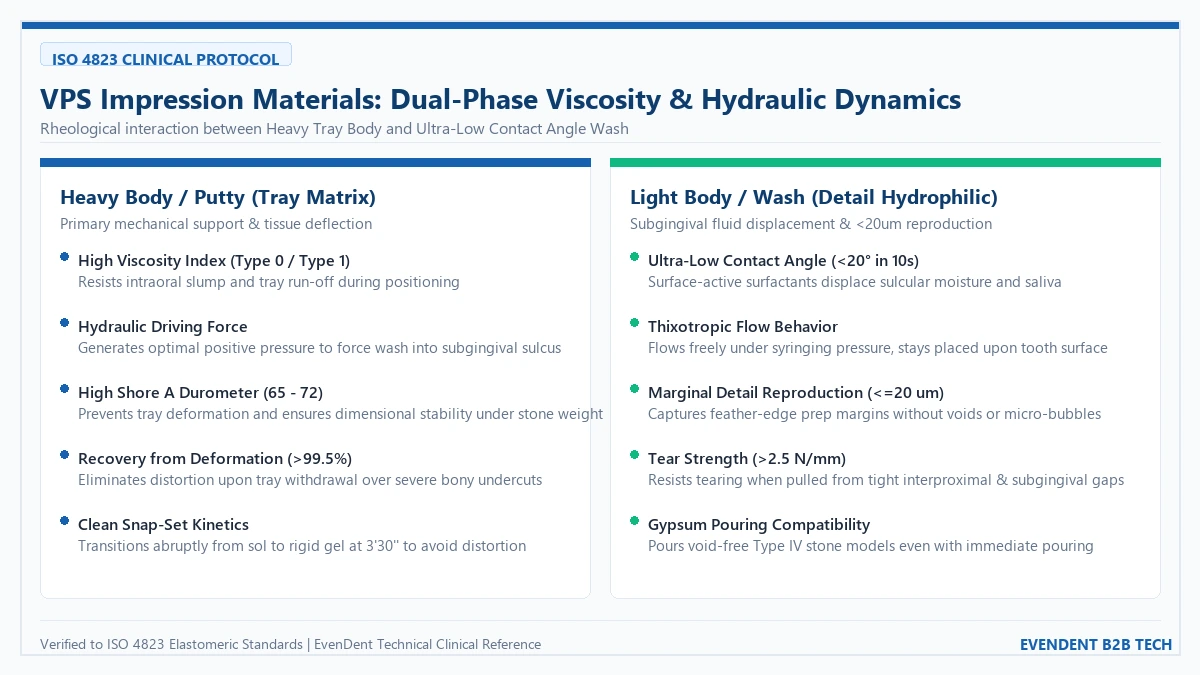
- Dynamic Wetting Velocity: Rather than waiting minutes, modern hydrophilic VPS reaches an equilibrium contact angle of under 20 degrees within 30 to 45 seconds, ensuring that light-body wash displaces sulcular moisture rather than trapping it.
2. Laboratory Benchmarks: Hydrophilic VPS vs. Traditional Elastomers
Measured under controlled laboratory conditions (23°C / 50% RH) on moist dentin substrates:
| Technical Property | Hydrophilic VPS (EvenDent Spec) | Generic Condensation Silicone (C-Silicone) | Traditional Polyether |
|---|---|---|---|
| Initial Contact Angle (0 sec) | 55° – 65° | 95° – 105° (Hydrophobic) | 40° – 50° (Naturally hydrophilic) |
| Dynamic Contact Angle (45 sec) | < 20° (Rapid spreading) | > 85° (Beading continues) | < 25° |
| ISO 4823 Detail Reproduction | 20 μm line continuous | 50 μm line | 20 μm line continuous |
| Elastic Recovery | > 99.6% | 98.0% – 98.5% | 98.5% – 99.0% |
| Volumetric Shrinkage (24h) | < 0.15% | 0.80% – 1.50% | < 0.25% |
| Gypsum Pouring Compatibility | Excellent (Smooth stone cast) | Fair (Occasional surface chalking) | Requires dry storage before pour |
| Tear Strength (Thin Margins) | > 4.5 MPa | 2.0 – 2.8 MPa | 2.5 – 3.2 MPa (Stiff removal) |
3. Thixotropic Rheology: Flow Under Pressure vs. Slump Resistance
Clinical impression taking requires conflicting physical states: the material must flow into sub-millimeter gingival crevices when syringing, yet resist gravitational dripping from maxillary preps:
- Thixotropic Shear-Thinning:
- Under high extrusion shear through automix tips and intraoral tips, the internal molecular bonds break down, dropping dynamic viscosity so the wash behaves like a fluid liquid.
- The moment the material settles around the tooth prep, viscosity rebounds instantly, preventing the wash from slumping into the floor of the mouth before tray seating.
4. Clinical Protocol: Moisture Control and Two-Phase Impression Syringing
Even with hydrophilic chemistry, excess standing saliva must be managed to achieve optimal marginal fidelity:
- Sulcular Hemostasis: Achieve complete gingival retraction and hemostasis using retraction cords or hemostatic gels; rinse thoroughly and air-dry gently until tooth surfaces display a satin sheen (moist, but free of standing fluid pools).
- Continuous Submerged Syringing:
- Insert the intraoral tip into the deepest part of the gingival sulcus.
- Extrude light-body wash continuously, keeping the nozzle submerged within the advancing silicone front to avoid air entrapment.
- Hydrodynamic Tray Pressure:
- Seat the tray loaded with putty or heavy-body within 30 seconds of wash placement.
- The hydraulic push of the rigid heavy body forces the low-viscosity hydrophilic wash deep into microscopic margin undercuts.
- Complete Passive Hold: Hold the tray immobile until the clinical setting time (typically 3 min 30 sec intraorally) concludes.
5. Wholesale Sourcing & Packaging Optimization
For dental supply distributors, clinic chains, and government tenders:
- Packaging Formats: 50 mL dual-barrel cartridges (1:1 / 2:1 ratio) with matching automixing tips and curved intraoral tips; bulk 380 mL 5:1 cartridges for automated mixing machines.
- Viscosity Options: Available in Light-Body, Regular-Body (Monophase), Heavy-Body, and Putty.
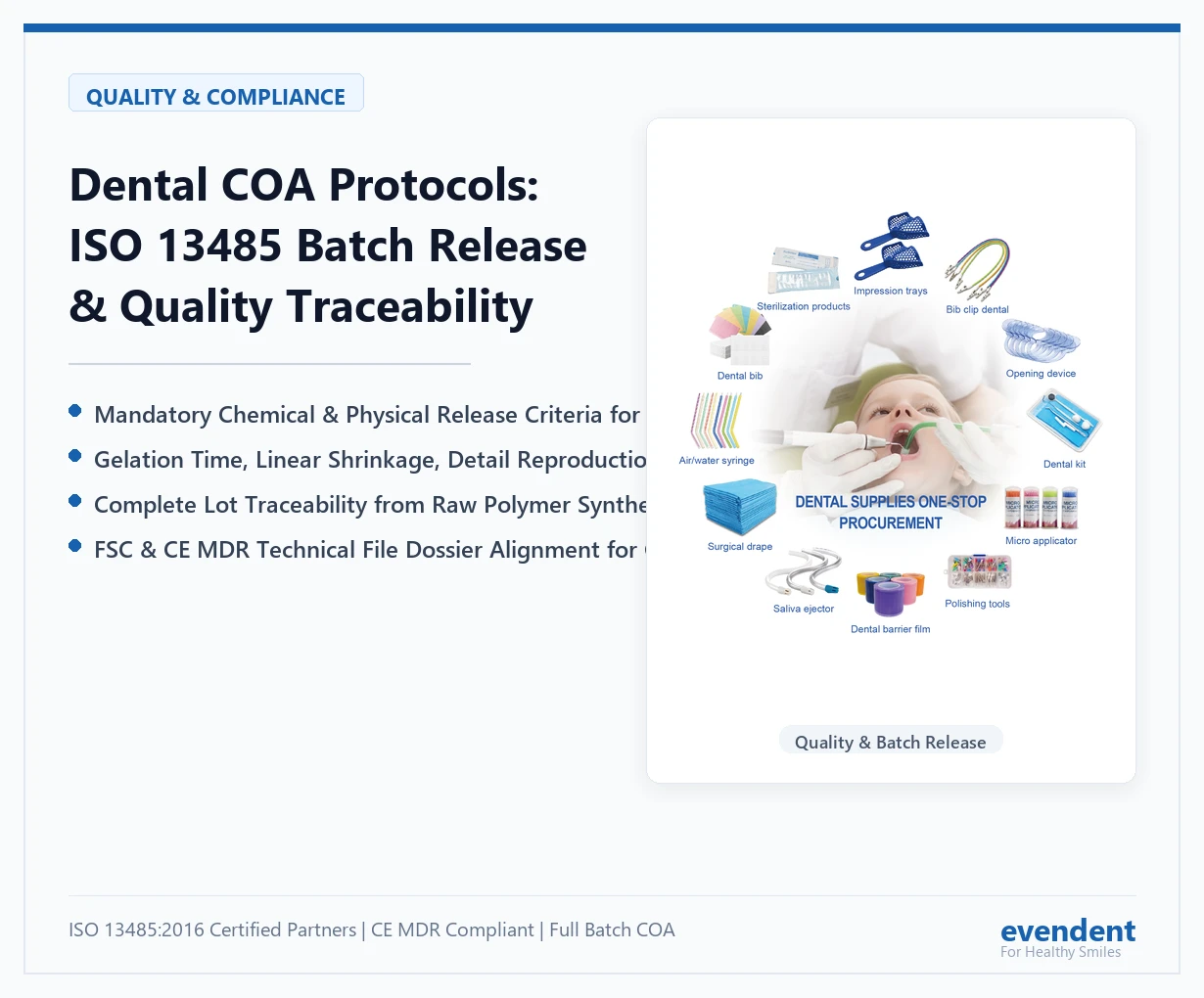
- Quality Standards: Sourced through partners operating under ISO 13485:2016 quality management systems with CE Class IIa certification compliant with ISO 4823:2015 (Dental elastomeric impression materials).
Related EvenDent Products & Guides:
– Products: silicone impression materials – full range in the Impression Materials category hub.
– Further Reading: VPS impression material guide.


 English
 Español
 Português
 Français
 Italiano
 Deutsch
 Русский
 日本語
 한국어
 العربية