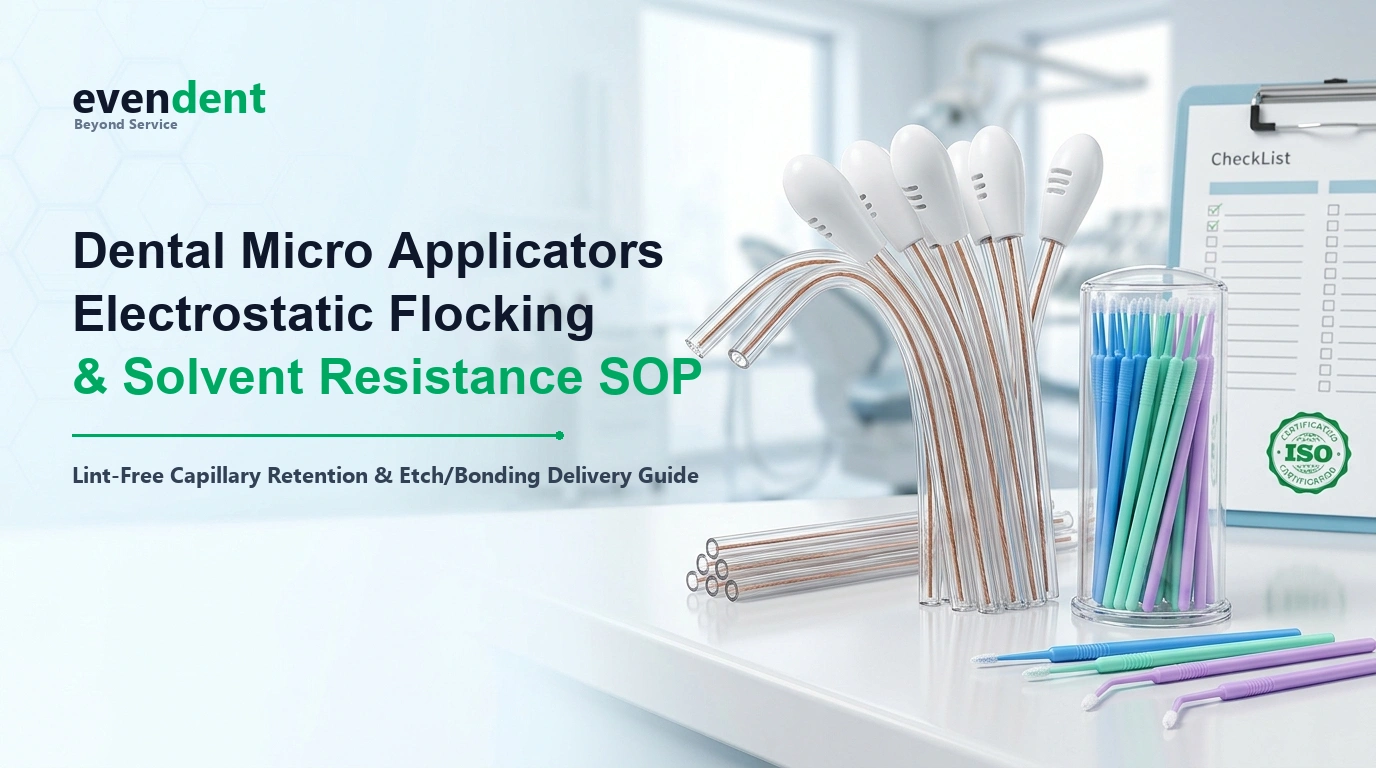

In modern direct adhesive dentistry, composite restorations, and ceramic veneer bonding, the application of dentin primers, universal adhesives, and etchants requires microscopic precision. A single foreign lint particle trapped within a 15 μm hybrid bonding layer can initiate localized debonding, marginal leakage, and recurrent caries.
While often treated as an everyday disposable, a professional dental micro applicator is an engineered precision instrument. Its non-absorbent synthetic fiber head relies on capillary suspension mechanics rather than porous absorption, delivering calibrated fluid doses without shedding debris or bending prematurely.
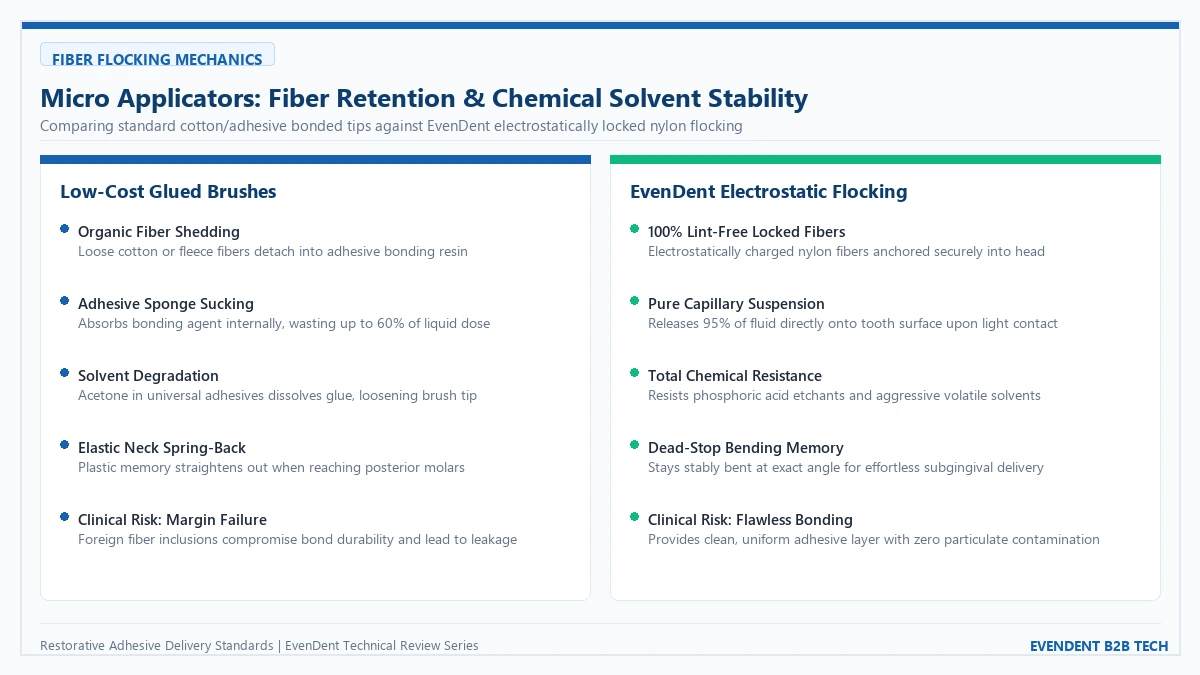
1. Electrostatic Flocking vs. Glued Cotton Swabs
Traditional cotton pellets and low-grade disposable brushes utilize water-soluble adhesives to affix loose cellulose fibers onto a plastic shank:
+------------------------------------------------------------------------+
|                MICRO APPLICATOR FLOCKING ARCHITECTURE                  |
+------------------------------------------------------------------------+
| Low-Grade Glued Applicator:                                            |
| Random cotton / rayon fibers attached via water-based glue             |
| ---> Contact with acetone / ethanol in dental adhesives                |
| ===> Glue dissolves; Fibers detach into restorative bonding margin      |
|                                                                        |
| EvenDent Electrostatic Non-Absorbent Nylon Flocking:                  |
| High-voltage electrostatic field aligns 100% polyamide fibers radially |
| ---> Permanent fusion into thermoplastic head                          |
| ===> Zero shedding, zero lint, complete solvent immunity               |
+------------------------------------------------------------------------+
The Non-Absorbent Capillary Suspension Principle
Unlike cotton fibers that absorb adhesive liquid into their hollow cellular cores (wasting up to 60% of expensive universal bonding agents), EvenDent’s synthetic polyamide fibers are solid and non-absorbent. Liquids are suspended entirely in the microscopic interstitial spaces between parallel bristles. Upon touching tooth enamel or dentin, surface tension differentials immediately transfer over 95% of the suspended droplet directly onto the prep site.
2. Chemical Solvent Resistance: Acetone, Ethanol & Phosphoric Acid
Contemporary dental adhesive systems utilize aggressive chemical carriers:
* Volatile Organic Solvents: Formulations containing acetone or high-concentration ethanol readily soften substandard polystyrene plastics and dissolve cheap flocking adhesives within seconds.
* Acid Etchants (37% H3PO4): Micro applicators are frequently employed to apply gel etchant around delicate margins.
* EvenDent Material Purity: Manufactured from medical-grade virgin polypropylene handles and chemically inert nylon fibers, EvenDent applicators maintain rigid structural integrity and zero fiber shedding even after prolonged soaking in acetone, silane coupling agents, and phosphoric acid.
3. Specifications & Sizing Calibration
EvenDent provides a standardized, color-coded applicator portfolio to accommodate diverse clinical access requirements:
| Applicator Size | Tip Diameter | Color Code | Ideal Clinical Indications | Liquid Retention Capacity |
|---|---|---|---|---|
| Regular | 2.5 mm | Blue / Green / Orange | Large Class I & II cavity preps; Silane priming of crowns | 12 – 15 μL |
| Fine | 2.0 mm | Yellow / Pink | Class III & V restorations; Root canal coronal seal | 8 – 10 μL |
| Ultra-Fine | 1.5 mm | White / Light Purple | Narrow veneer margins; Post space adhesive placement | 4 – 6 μL |
| Cylinder / Bendable | 1.2 mm Narrow | Assorted | Periodontal pocket medicament delivery | 3 – 5 μL |
4. Ergonomic Neck Memory Mechanics
Accessing the disto-occlusal margin of an upper second molar or an undercut post space requires acute instrument angulation:
* Zero Elastic Spring-Back: EvenDent applicator shanks incorporate a precision-notched ductile hinge zone. Clinicians can bend the head up to 90 degrees with gentle finger pressure.
* Stable Angle Retention: Once bent, the handle remains locked at the exact specified angle throughout the entire restorative application, without slowly springing back straight and bumping against the patient’s buccal mucosa.
* Cleanroom Packaging: Supplied in contamination-free dispensers of 100 units (4 tubes per box, 400 units total), engineered to dispense a single sterile applicator per shake while protecting remaining stock from operatory aerosols.

 English
 Español
 Português
 Français
 Italiano
 Deutsch
 Русский
 日本語
 한국어
 العربية