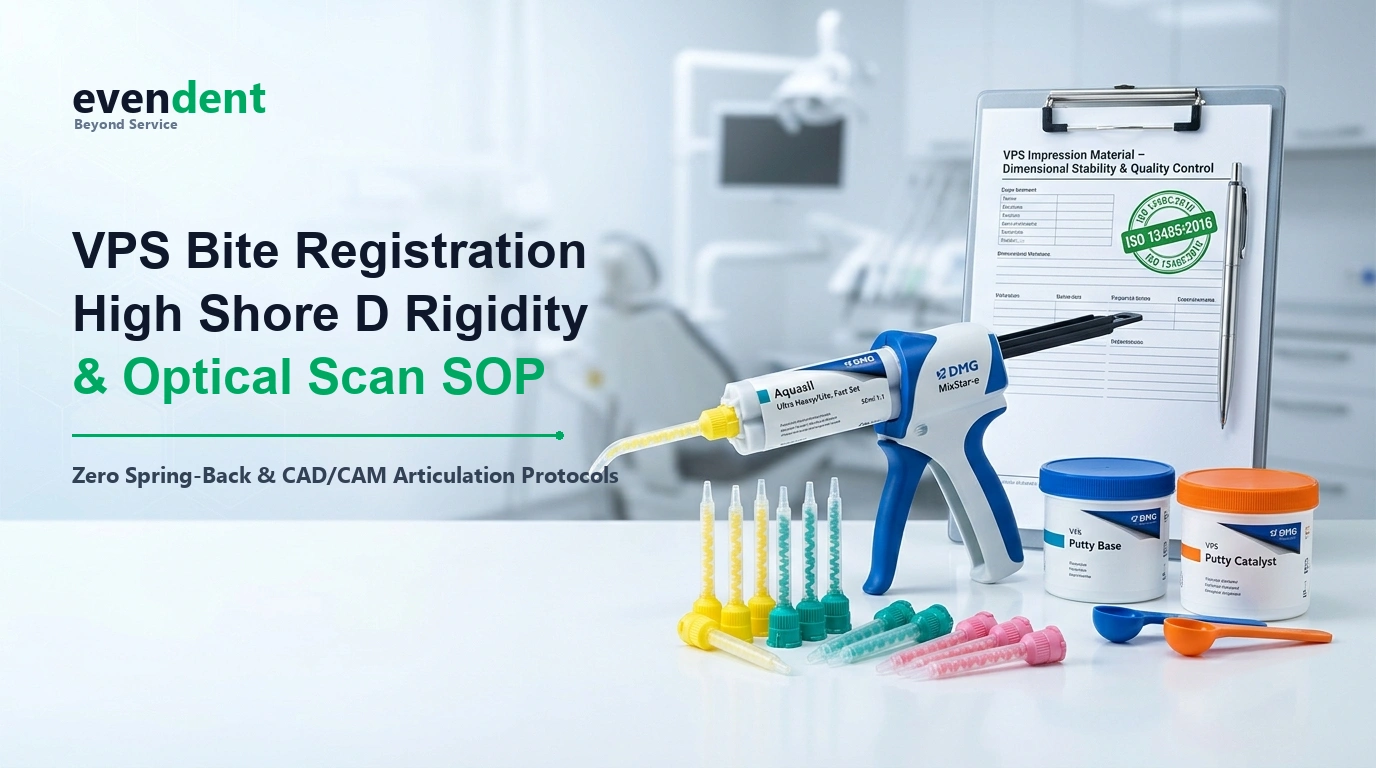

In complex prosthodontic reconstructions, full-arch crown and bridge rehabilitations, and CAD/CAM milling workflows, interocclusal registration forms the cornerstone of accurate jaw relations. For decades, clinicians relied on baseplate wax, zinc oxide eugenol (ZOE) pastes, or condensation silicones. However, wax suffers from thermal distortion and elastic memory, while standard elastomeric wash materials exhibit spring-back flexure that prevents models from seating fully into dental articulators.
Modern Addition Silicone (VPS) Bite Registration Materials resolve these biomechanical limitations by delivering ultra-high terminal hardness, snap-set kinetics, and powder-free optical reflectance for lab scanners.
1. Biomechanical Comparison: VPS vs. Baseplate Wax vs. Polyether
The accuracy of an interocclusal record depends upon two primary physical traits: zero resistance during patient mandibular closure (preventing deviation from centric relation) and absolute rigidity once polymerized (preventing articulator spring-back):
+------------------------------------------------------------------------+
|                   OCCLUSAL REGISTRATION PROFILE DYNAMICS               |
+------------------------------------------------------------------------+
| Traditional Bite Wax:                                                  |
| Thermal distortion during transport; soft flexure under model weight    |
| ===> False open bite; excessive chairside occlusal grinding            |
|                                                                        |
| EvenDent High-Rigidity VPS Bite Material:                              |
| Creamy thixotropic sol phase (zero tooth deflection during closure)    |
| ---> Rapid 30s Snap-Set ---> Stone-hard Shore D > 45 Matrix            |
| ===> Passive, positive cast indexing with ZERO spring-back             |
+------------------------------------------------------------------------+
The “Spring-Back” Hazard
- When standard impression silicones (Shore A 60–70) are placed between upper and lower stone casts on an articulator, the laboratory technician must apply downward pressure to seat the casts into the intercuspal indentations.
- The elastic silicone flexes under this compressive load; once the technician releases hand pressure, the rubber springs back elastically, lifting the stone teeth out of contact by 50 to 150 μm.
- The Clinical Penalty: The resulting dental bridge or ceramic crown is milled or cast in “hyper-occlusion”, requiring extensive and tedious occlusal grinding chairside.
- EvenDent Ultra-Rigid Formulation: Reaches a final durometer hardness of Shore D 45 to 48 (equivalent to Shore A > 95), behaving like a rigid acrylic jig that will snap cleanly if bent rather than flex elastically.
2. Technical Performance Matrix: Physical & Optical Benchmarks
Tested according to ISO 4823 (Elastomeric impression materials) laboratory specifications:
| Technical Parameter | EvenDent Rigid VPS Bite | Standard Flexible VPS Wash | Traditional Baseplate Wax | Acrylic Resin Jigs |
|---|---|---|---|---|
| Terminal Hardness | Shore D 45 – 48 | Shore A 65 – 70 | Variable with ambient temp | Rockwell M 80+ |
| Working Time (23°C) | 30 seconds | 1 min 30 sec | Variable (Softened by flame) | 1 min 00 sec |
| Intraoral Setting Time | 30 – 45 seconds | 3 min 30 sec | 60 seconds (Cold water rinse) | 2 min 00 sec |
| Spring-Back Flexibility | 0.0% (Rigid Fracture) | 4.5% – 8.0% Elastic flex | Permanent plastic warp | 0.0% |
| Trimmability (Scalpel/Bur) | Clean carving without tear | Troughs & drags under bur | Melts & smears on cutter | Hard; emits monomer smell |
| Powder-Free Optical Scan | Excellent (Matte reflection) | Poor (Glare & dispersion) | Incompatible with scanner | Needs anti-glare spray |
3. Optical Reflectance for Digital Desktop and Intraoral Scanning
In modern digital dental laboratories, articulated casts are digitized using structured-light or laser optical scanners:
- Diffused Light Scattering: Generic translucent silicones cause internal laser refraction and surface glare, producing digital “noise”, hole artifacts, and corrupted point clouds in CAD software.
- High-Opacity Mineral Fillers: EvenDent VPS Bite materials incorporate dense, micro-fine titanium oxide and barium sulfate pigments. This creates a uniform matte, non-reflective surface that provides high optical contrast for 3D scanners without requiring messy titanium dioxide contrast spray.
4. Clinical Protocol: Syringing and Articulator Trimming
To guarantee zero intercuspal interference when mounting study or master casts:
- Direct Quadrant Extrusion:
- Mount the automix tip and bleed a small bead of material onto a mixing pad to verify simultaneous Base and Catalyst flow.
- Syringe the material directly along the occlusal surfaces of prepared teeth and adjacent anchoring molars.
- Guided Centric Closure:
- Instruct the patient to close firmly into the verified centric relation (or habitual maximum intercuspation).
- Because the paste has a soft, mousse-like initial consistency, it presents zero hydraulic resistance, preventing the patient from deflecting into an unnatural forward or lateral eccentric posture.
- Cross-Arch Trimming with Lab Scalpel:
- Once removed after 45 seconds, inspect the record.
- Crucial Step: Using a sharp #11 or #15 lab blade, slice away all soft-tissue indentations and deep interproximal flash, preserving only the microscopic cusp-tip indentations (0.5 mm deep).
- Leaving excess silicone in the fissures or vestibules will prevent stone models from seating completely due to stone blebs.
5. Wholesale Sourcing & Packaging Standardization
For dental distributors, prosthodontic specialty clinics, and commercial dental labs:
- Packaging Formats: Standard 50 mL dual-barrel cartridges (1:1 ratio); 2 cartridges per box with 12 green high-flow automix tips; bulk clinic packs containing 10 cartridges.
- Color Formats: High-contrast Turquoise Blue or Violet for instant visual identification of thin margin penetration.
- Regulatory Documentation: Sourced through partners operating under ISO 13485:2016 quality management systems with CE Class IIa certification compliant with ISO 4823 standards, accompanied by full batch-specific Certificates of Analysis (COA).
Related EvenDent Products & Guides:
– Products: silicone impression materials – full range in the Impression Materials category hub.
– Further Reading: VPS impression material guide.
 English
 Español
 Português
 Français
 Italiano
 Deutsch
 Русский
 日本語
 한국어
 العربية