
In modern endodontic therapy, instrumentation shapes the root canal, but irrigation cleans it. Due to complex anatomical variations—such as lateral canals, apical deltas, isthmuses, and curved canals—mechanical nickel-titanium (NiTi) files can leave over $35\%$ of canal wall surface untouched. Chemical debridement using sodium hypochlorite ($\text{NaOCl}$) and ethylenediaminetetraacetic acid ($\text{EDTA}$) is essential to dissolve necrotic tissue, eliminate biofilm, and remove the smear layer.
However, delivering liquid irrigants to the apical third without forcing caustic chemicals past the apical foramen into periapical tissues is one of the most delicate challenges in dentistry. A sodium hypochlorite extrusion accident causes excruciating patient pain, immediate tissue necrosis, severe facial swelling, and extensive clinical downtime.
The safety and efficacy of your chemical debridement depend fundamentally on your choice of Endodontic Irrigation Needle.
This clinical and procurement guide examines the hydrodynamics of different needle tip designs, compares standard gauge sizes ($27\text{G}$, $30\text{G}$, $31\text{G}$), and outlines safe clinical protocols for dental practices and medical distributors.
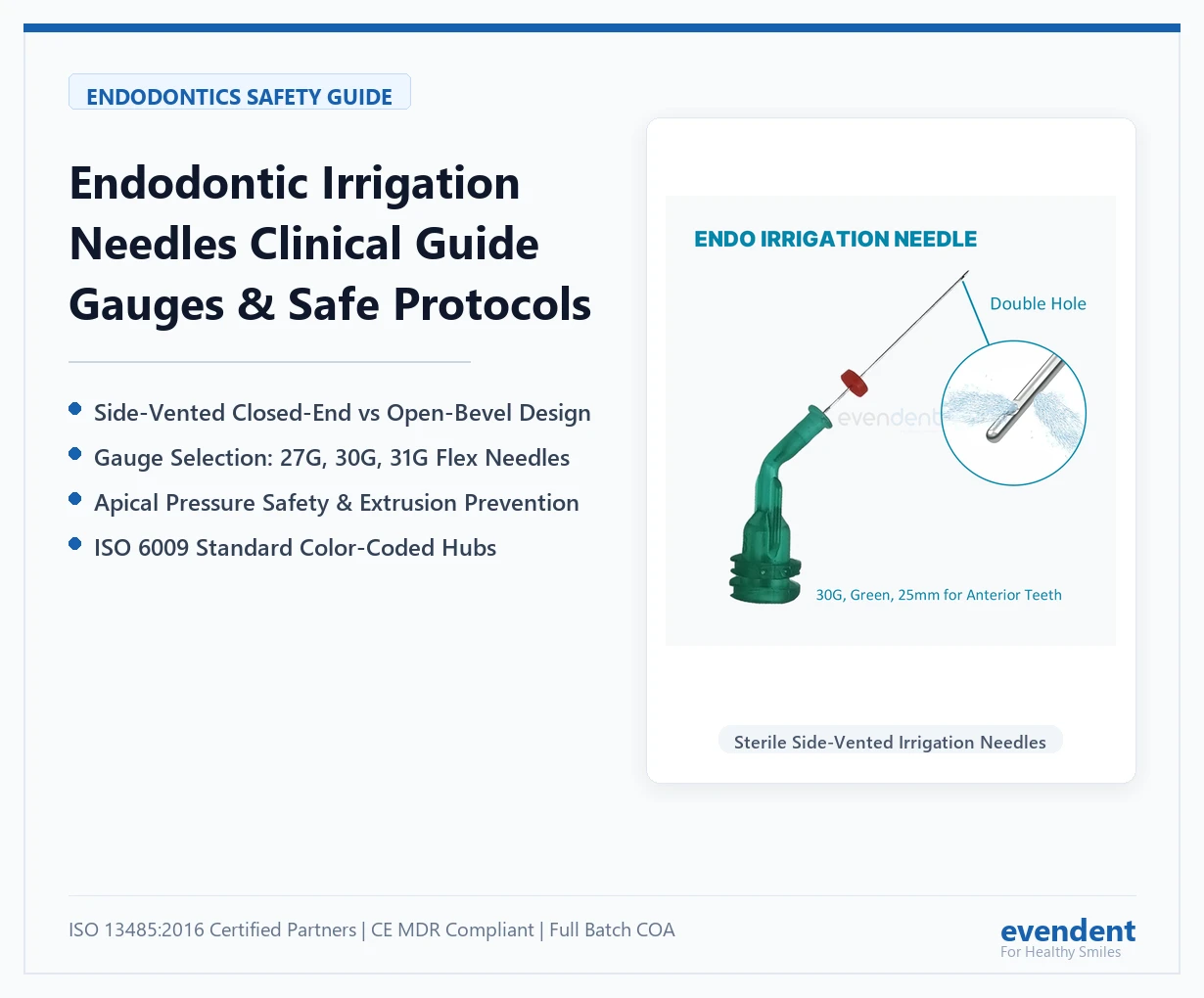
1. Needle Tip Geometries: Why Side-Vented Needles Prevent Apical Accidents
The geometric design of the needle tip dictates the fluid exit velocity, vortex dynamics, and apical pressure.
1. Open-Ended (Flat / Beveled)  ───► High positive jet pressure directly forward (HIGH EXTRUSION RISK)
2. Side-Vented (Closed-End)     ───► Fluid jets laterally against canal walls; zero forward pressure
3. Double Side-Vented           ───► Balanced dual-lateral jets; creates cleansing hydrodynamic vortex
1.1 Open-Ended Needles (Flat, Beveled, or Notched)
- Design: Fluid exits straight through the open distal tip.
- Hydrodynamics: Creates an aggressive forward fluid jet. If the needle binds in the apical third, the hydraulic pressure forces $\text{NaOCl}$ directly out of the apical foramen into periradicular bone and soft tissue.
- Clinical Consensus: Contraindicated for root canal irrigation in the apical third. Strictly reserved for coronal flushing or general periodontal pocket debridement.
1.2 Closed-End, Single Side-Vented Needles
- Design: The distal tip is rounded and permanently sealed; irrigant exits through a micro-aperture located $1.0 – 1.5\text{ mm}$ back from the tip on one side.
- Hydrodynamics: Eliminates forward positive pressure. The liquid hits the lateral canal wall, generating mechanical shear stress that scours biofilm without pushing chemical fluid past the apex.
1.3 Double Side-Vented Needles
- Design: The tip is sealed, with two opposed lateral vent ports positioned slightly offset from each other.
- Hydrodynamics: Generates balanced, opposing lateral hydrodynamic turbulence. This creates an upward reflux vortex that lifts detached debris coronally while neutralizing any unilateral deflection forces on delicate apical canal walls.
2. Needle Gauge & Diameter Specifications ($27\text{G}$ vs. $30\text{G}$ vs. $31\text{G}$)
In endodontics, needle gauge follows the Birmingham Gauge system, where a higher gauge number indicates a smaller needle diameter.
To be clinically effective, the needle tip must reach within $1.0\text{ mm}$ to $1.5\text{ mm}$ of the working length ($\text{WL}$) without binding against canal walls.
| Gauge Size | External Diameter ($\text{OD}$) | Internal Diameter ($\text{ID}$) | Minimum Canal Preparation Size | Primary Clinical Indication |
|---|---|---|---|---|
| $27\text{G}$ | $0.41\text{ mm}$ (approx. #40 file) | $0.21\text{ mm}$ | ISO #45 or larger | Coronal third flaring, palatal roots of molars, wide anterior canals |
| $30\text{G}$ | $0.31\text{ mm}$ (approx. #30 file) | $0.16\text{ mm}$ | ISO #30 to #35 | The Global Golden Standard: Routine molar, premolar, and curved canals |
| $31\text{G}$ | $0.26\text{ mm}$ (approx. #25 file) | $0.13\text{ mm}$ | ISO #25 to #30 | Severely curved, narrow, or calcified root canals |
The $30\text{G}$ Dominance:
Across international endodontic protocols, $30\text{ Gauge}$ side-vented needles account for over $75\%$ of clinical demand. A $30\text{G}$ needle has an outer diameter of $0.31\text{ mm}$, permitting safe, unhindered placement to within $1\text{ mm}$ of the apex in canals prepared to an ISO #30 or #35 master apical file.
3. Safe Clinical Irrigation Protocols: 5 Golden Rules
Even with premium side-vented needles, proper operator technique is mandatory to guarantee patient safety:
- Verify Needle “Looseness” (Never Bind): The needle must always fit loosely inside the canal. If you feel resistance or wedging, pull back $2\text{ mm}$. A bound needle transforms into a closed hydraulic piston, forcing liquid into the periapex regardless of tip design.
- Maintain Constant In-and-Out Movement: Move the needle continuously with a gentle $2 – 3\text{ mm}$ amplitude vertical stroke during fluid expression. This movement agitates the irrigant and prevents localized pressure buildup.
- Gentle Plunger Pressure: Depress the syringe plunger smoothly using light index-finger pressure. Never use excessive force. If the plunger resists, withdraw slightly to clear debris.
- Pre-Bend for Curved Canals: Premium stainless steel needle shafts feature high ductility, allowing the clinician to pre-bend the needle to match the curvature of the root without kinking or occluding the internal lumen.
- Set an Endodontic Stopper: Always slide a silicone measuring stop onto the needle shaft set to $\text{WL} – 2\text{ mm}$ to prevent accidental over-insertion into the periapical space.
4. Manufacturing Quality & Sourcing Benchmarks
When sourcing endodontic needles in bulk, purchasing managers and distributors should evaluate the following structural specifications:
- Medical-Grade Stainless Steel (SUS 304): Flexible yet fracture-resistant, allowing multiple pre-bends in complex root anatomies.
- Standard Luer Lock Hub: Polypropylene threaded luer-lock hub that locks securely onto disposable irrigation syringes to prevent high-pressure blowouts during viscous paste or chemical delivery.
- Color-Coded Hubs (ISO Standard): Immediate clinical identification in the operatory (e.g., Yellow for $30\text{G}$, Grey for $27\text{G}$, Orange for $31\text{G}$).
- Burr-Free Ultrasonic Polishing: Micro-polished surfaces with rounded atraumatic tips that glide past root canal ledges without gouging dentin.
- Sterile Packaging: Individually blister-sealed or sealed in sterile pouches of 100 pieces per box, sterilized by Ethylene Oxide ($\text{EO}$).
5. Sourcing & Packaging Configurations for Wholesalers
- Standard Box Packaging: 100 needles per box, individually blister-wrapped with lot number and expiration date clearly stamped.
- Master Export Cartons: 100 boxes per carton = 10,000 pieces per master carton ($42 \times 32 \times 28\text{ cm}$, approx. $6.5\text{ kg}$).
- Regulatory Compliance: Manufactured under ISO 13485 and CE Class IIa / Class I MDR compliance, complete with batch release COAs and non-dangerous goods transport documentation.
Freight Tip for Importers: Endodontic needles are extremely compact, lightweight medical devices. Consolidating needle master cartons with high-volume, bulk goods—such as Dental Bibs, Alginate Impression Materials, or Dental Stone—maximizes container space without incurring standalone international courier or LCL handling surcharges.
Summary & Clinical Takeaways
- Avoid open-ended needles for apical root canal irrigation; they present an unacceptable risk of chemical extrusion.
- Standardize on $30\text{G}$ side-vented needles for predictable safety, deep apical penetration, and lateral hydrodynamic biofilm debridement.
- Always verify passive needle fit and maintain dynamic in-and-out movement during fluid delivery.
Partner with EvenDent for Your Endodontic Supplies
At EvenDent, we provide worldwide dental practices, hospitals, and distributors with certified, precision-engineered endodontic consumables.
- Superior Safety Design: Side-vented and double-side-vented tips with rounded, closed ends to ensure complete periapical protection.
- Precision Gauges Available: Complete range of $27\text{G}$, $30\text{G}$, and $31\text{G}$ needles with secure Luer Lock hubs.
- Full Regulatory Backing: Manufactured under ISO 13485 partner quality control with CE registration, Free Sales Certificates (FSC), and full batch traceability.
Elevate your endodontic safety standards:
- 👉 Request Free Clinical Samples & Wholesale Price Lists
- Explore Our Endodontic Catalog: View our complete Endodontic Supplies Category Hub or contact our export team via WhatsApp at +86 180 1638 1172.
Frequently Asked Questions (FAQ)
Q1: What should I do immediately if a sodium hypochlorite extrusion accident occurs?
A: Immediately stop irrigation. Anesthetize the area if necessary, flush the canal with copious sterile saline (not more chemical), instruct the patient to apply cold compresses for the first 24 hours (switching to warm compresses thereafter), prescribe analgesics, and monitor closely for secondary infection.
Q2: Can endodontic irrigation needles be autoclaved and reused?
A: No. Endodontic needles are single-use disposable medical devices. Reusing needles risks lumen blockage from dried chemical precipitates, metal fatigue failure inside curved canals, and serious cross-contamination.
Q3: What is the benefit of pre-bending an irrigation needle?
A: Pre-bending allows the needle shaft to follow the anatomical curvature of mesial roots in mandibular molars or buccal roots in maxillary molars, enabling the tip to reach the apical third without binding against the coronal dentin shelf.

 English
  Español
  Português
  Français
  Italiano
  Deutsch
  Русский
  日本語
日本語  한국어
한국어  العربية