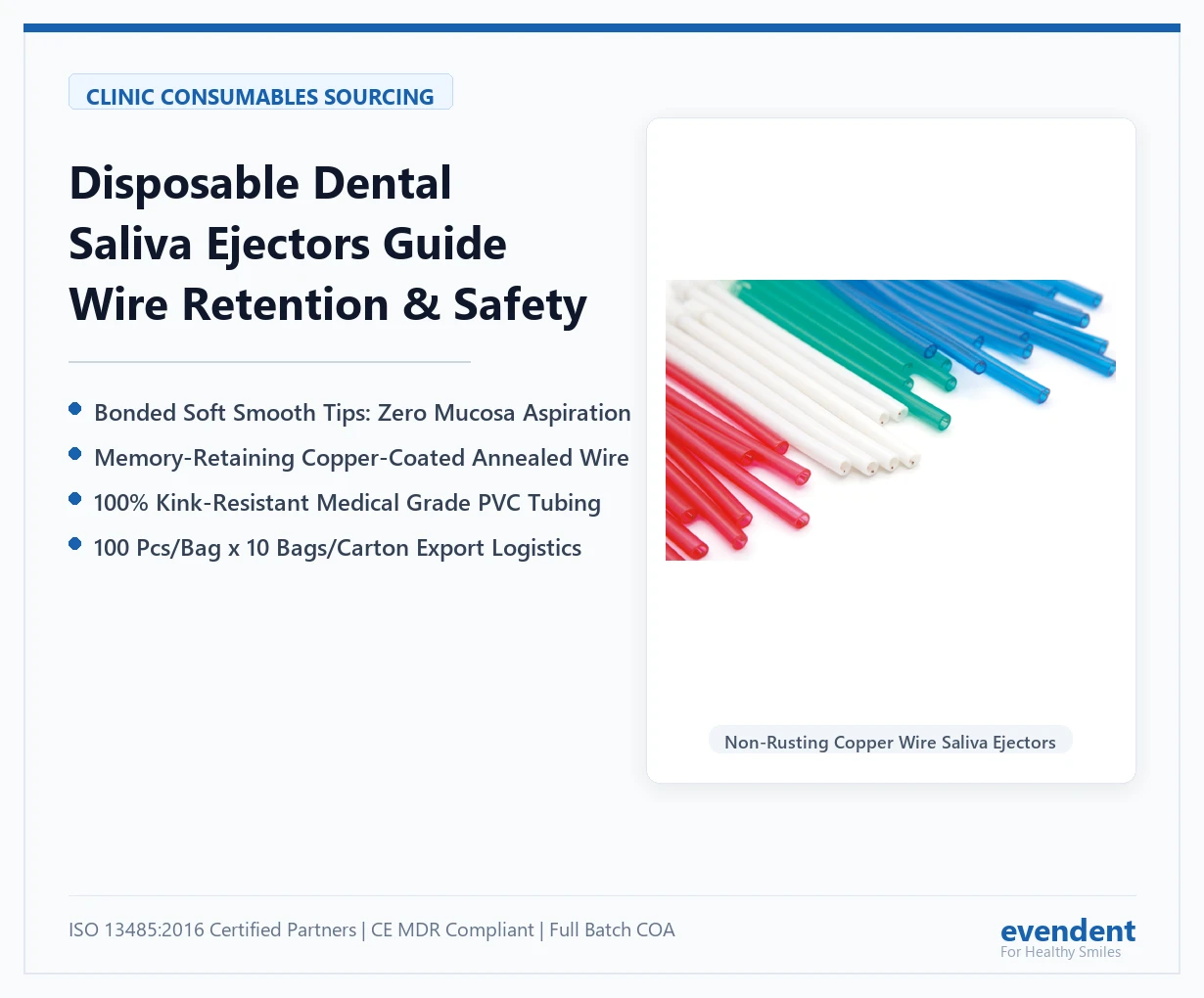

In operative, restorative, and hygiene dentistry, maintaining a dry, clean working field is paramount for clinical success. Moisture, blood, and salivary pooling compromise adhesive composite bonding, obscure tooth margin visualization, and elevate cross-contamination risks.
Among all dental evacuation devices, disposable saliva ejectors (low-volume suction tubes) are the undisputed workhorses of every operatory. Used during scaling, composite fillings, crowns, orthodontic bonding, and prophylaxis, every single patient visit consumes between one and three ejectors.
For dental supply distributors, clinic networks, and hospital purchasing groups, sourcing saliva ejectors in bulk requires balancing low unit cost with strict clinical safety.
A substandard saliva ejector with an exposed metal wire can lacerate fragile sublingual tissues, while a detachable tip poses an unacceptable patient aspiration hazard.
This technical B2B buyer’s guide breaks down the essential mechanical engineering, safety tip designs, medical-grade PVC formulations, and container freight calculations for wholesale dental procurement.
1. Technical Anatomy of a Wire-Reinforced Saliva Ejector
A quality saliva ejector appears simple, but relies on sophisticated co-extrusion manufacturing:
[Soft-Bonded Safety Tip]     ───► Non-removable design prevents aspiration; side vents stop tissue grabbing
[Medical-Grade PVC Tube]     ───► Flexible, kink-resistant, transparent or solid non-toxic tube wall
[Annealed Copper-Clad Wire]  ───► Seamlessly embedded in the tube wall; holds any bend without spring-back
1.1 The Role of the Internal Memory Wire
Unlike high-volume evacuation (HVE) tips that are held continuously by a dental assistant, saliva ejectors are frequently curved into a “J-shape” or fishhook configuration to hang autonomously over the patient’s lower lip into the lingual sulcus.
* Annealed Copper-Clad Steel Wire: Premium ejectors utilize dead-soft annealed wire. It bends smoothly with minimal finger pressure and retains its curved contour with zero spring-back.
* Anti-Perforation Shielding: Cheap ejectors use poorly coated or brittle iron wire that can puncture through the tube wall when bent sharply, scratching mucosal tissues. A quality ejector fully encapsulates the wire within the extruded PVC wall, with ends securely rounded.
1.2 Fixed Bonded Tips vs. Removable Caps (Aspiration Safety)
- Removable Cap Designs (High Risk): Older designs feature a push-fit plastic cap. Under strong negative chairside suction or patient tongue movements, these caps can dislodge and be swallowed or aspirated into the lungs—a severe medical emergency.
- Non-Removable Fused Safety Tips (Modern Standard): Premium saliva ejectors utilize ultrasonically welded or thermally fused soft tips. The tip cannot be separated from the tube even under manual tensile forces exceeding $40\text{ N}$.
2. Quality Benchmarks: Material Safety & Suction Hydrodynamics
When evaluating supplier samples, test for these four mechanical and clinical specifications:
| Quality Specification | Standard Commercial Grade | Premium Medical Grade | EvenDent Quality Benchmark |
|---|---|---|---|
| Tube Material | Standard Industrial PVC | Medical-grade Non-toxic PVC | Phthalate-Free, Odorless Medical PVC |
| Kink Resistance | Collapses under sharp $90^\circ$ bend | Resists kinking; maintains lumen | 100% Full Lumen Airflow Retained |
| Tip Safety Design | Removable push-fit cap | Thermally bonded smooth cap | Non-Removable Welded Safety Tip |
| Tissue-Grabbing Risk | High (single end aperture) | Low (perimeter lateral vents) | Multi-Slit Venting Prevents Mucosal Grabbing |
| Wire Memory | Partial spring-back after 5 min | Holds contour indefinitely | Zero Spring-Back Dead-Soft Wire |
| Wire Puncture Rate | $1 – 2\%$ on sharp bends | Zero defect | 100% Encapsulated Wire; Zero Puncture |
Why Multi-Slit Lateral Venting Matters:
When a saliva ejector rests on the delicate floor of the mouth, continuous suction can pull sublingual mucosa directly against the tip, causing painful tissue grabbing and localized hematomas.
High-grade saliva ejector tips incorporate perforated lateral vents around the perimeter. If the distal opening contacts tissue, air and saliva continue to flow through the side slots, breaking the direct suction seal and protecting mucosal integrity.
3. Dimensions, Formats & Color Selection
3.1 Standard Industry Dimensions
- Standard Length: $150\text{ mm}$ (approx. $5.9”$) – The global standard length that fits standard $6.5\text{ mm}$ low-volume suction valve couplings.
- Outer Diameter: $6.5\text{ mm}$ – Universal fit for all dental chair delivery units (A-dec, Belmont, Sirona, Planmeca).
3.2 Visual & Aesthetic Variations
Saliva ejectors are available in diverse color palettes to match clinic decor or practice branding:
* Clear Tube with Colored Tip: (Clear tube with Blue, Green, Pink, Yellow, or White tip) – Allows immediate visual verification of fluid evacuation.
* Solid Opaque Colors: Blue, White, Pink, Mint Green, Purple, Sunshine Yellow.
* Solid Black: Highly demanded in aesthetic facial clinics, orthodontic aligner studios, and specialized surgical suites.
4. Wholesale Packaging Configurations & Container Shipping Logistics
Because saliva ejectors are hollow plastic tubes, they are CBM-intensive (volumetric) products. Optimizing container packing is critical to minimizing the landed cost per unit.
4.1 Master Carton Specifications
- Inner Packaging: 100 pieces per heat-sealed transparent polybag.
- Master Export Carton: 10 bags per carton = 1,000 pieces per carton.
- Carton Dimensions (Typical): $32\text{ cm} \times 24\text{ cm} \times 16\text{ cm}$ (approx. $0.012\text{ CBM}$).
- Gross Weight: Approx. $4.5 – 5.0\text{ kg}$ per carton.
4.2 Full Container Load (FCL) Capacity:
- 20ft General Purpose Container (20GP): Holds approximately 2,000 – 2,200 master cartons ($2,000,000 – 2,200,000$ pieces).
- 40ft High Cube Container (40HQ): Holds approximately 4,500 – 4,800 master cartons ($4,500,000 – 4,800,000$ pieces).
Sourcing Strategy for Distributors: If you do not require a full container of saliva ejectors, consolidate your order with high-density goods. Sourcing saliva ejectors alongside Dental Bibs, Dental Stone (Type IV), and Alginate Impression Materials allows you to mix pallets, maximizing container space and slashing ocean freight costs per unit.
5. Regulatory & Compliance Standards
To prevent border delays, ensure your supplier provides complete compliance paperwork:
- [ ] ISO 13485:2016 Certification: Proof of medical-grade quality management.
- [ ] CE Declaration / Class I Registration: Compliant with EU Medical Device Regulations (MDR).
- [ ] Phthalate-Free & Biocompatibility Testing: Free from toxic plasticizers (DEHP-free) and compliant with REACH/RoHS directives.
- [ ] Non-Restricted Transport Certificate: Ensuring zero dangerous-goods surcharges on air and sea freight.
Summary Sourcing Checklist for Saliva Ejectors
- Insist on Fused Non-Removable Tips: Prevent life-threatening patient aspiration incidents.
- Verify Dead-Soft Memory Wire: Ensure the tube holds its shape without springing back out of the patient’s mouth.
- Check Wire Ends for Sharp Edges: Confirm the wire is recessed and completely enveloped by the soft tip and bottom cut.
- Demand Phthalate-Free Medical PVC: Protect patients from chemical odors and harmful plasticizers.
Partner with EvenDent for Your Dental Consumables Supply
At EvenDent, we provide global dental supply depots, dental hospital networks, and medical wholesalers with dependable, high-volume consumables.
- 100% Aspiration-Safe: Ultrasonically bonded, smooth-edged soft tips with multi-vent anti-tissue grabbing technology.
- Superior Wire Memory: Kink-resistant, dead-soft copper-clad wire that holds its shape indefinitely.
- Full Regulatory Backing: Manufactured in ISO 13485 partner facilities with CE Class I registration and full batch traceability.
- Consolidated Shipping: Ship mixed pallets of saliva ejectors, dental bibs, micro applicators, and impression materials in a single container.
Upgrade your clinical suction supplies today:
- 👉 Request Free Product Samples & Wholesale Price Lists
- Explore Our Complete Product Lines: View our Oral Consumables Category Hub or contact our export team via WhatsApp at +86 180 1638 1172.
Frequently Asked Questions (FAQ)
Q1: Can disposable saliva ejectors be autoclaved and reused?
A: Absolutely not. Disposable saliva ejectors are strictly single-use devices. Autoclaving melts the medical PVC tubing and damages the internal wire. Reusing suction devices poses an extreme risk of cross-contamination and bloodborne pathogen transmission.
Q2: Why does an ejector occasionally spring back after being bent?
A: Spring-back occurs when manufacturers use spring-temper steel or unannealed industrial wire rather than dead-soft annealed copper-clad wire. High-grade saliva ejectors stay bent indefinitely until manually reshaped.
Q3: What is the shelf life of medical PVC saliva ejectors?
A: When stored in a cool, dry place away from direct sunlight, disposable saliva ejectors have a stable shelf life of 5 years.

 English
  Español
  Português
  Français
  Italiano
  Deutsch
  Русский
  日本語
日本語  한국어
한국어  العربية