
In precision crown, bridge, and implant prosthodontics, the dimensional fidelity of an impression elastomer is only as reliable as its mechanical retention to the impression tray. While addition silicones (VPS) exhibit near-zero dimensional shrinkage (<0.15%), they possess virtually no natural chemical affinity for standard polystyrene plastic or stainless steel tray walls.
During tray removal over pronounced bony undercuts, severe hydraulic suction forces act to pull the polymerized rubber away from the tray wall. Even a microscopic, sub-clinical detachment of 0.1 mm produces a distorted stone master die—resulting in high occlusal contacts, open margins, and restoration remakes.
Applying a specialized VPS tray adhesive provides the indispensable chemical and mechanical bridge required to guarantee absolute interfacial stability.
1. The Interfacial Chemistry: Silane Coupling & Organo-Polymers
Unlike alginate adhesives that rely primarily on sticky resins, VPS tray adhesives operate through molecular silane coupling:
+------------------------------------------------------------------------+
|                   SILANE MOLECULAR COUPLING DYNAMICS                   |
+------------------------------------------------------------------------+
| Tray Substrate (Rigid Plastic-Steel or Stainless Steel)                |
|                             |                                          |
|            [Covalent / Micromechanical Priming]                        |
|                             v                                          |
| EvenDent Tray Adhesive (Ethyl Silicate & Polydimethylsiloxane Primer)  |
|                             |                                          |
|            [Cross-Linking Polyaddition Reaction]                       |
|                             v                                          |
| Set VPS Elastomer Matrix (Heavy Body / Monophase / Putty)              |
| ===> Continuous Interfacial Bond: Interfacial Peel Strength > 1.5 MPa   |
+------------------------------------------------------------------------+
The Mechanism of Covalent Bonding
EvenDent VPS Tray Adhesive contains reactive polyalkylsilicates and silicone polymers dissolved in a fast-evaporating ethyl acetate solvent carrier:
1. Substrate Wetting: The solvent lowers surface tension, allowing the active silane polymers to flow into microscopic surface pits on plastic impression trays.
2. Solvent Evaporation: Over 3 to 5 minutes, volatile solvents flash off, leaving a dry, high-energy tacky silane polymer film.
3. Cross-Linking Reaction: When fresh VPS is injected into the tray, vinyl groups in the unpolymerized silicone cross-link covalently with active functional groups in the adhesive film, creating a permanent cohesive bond.
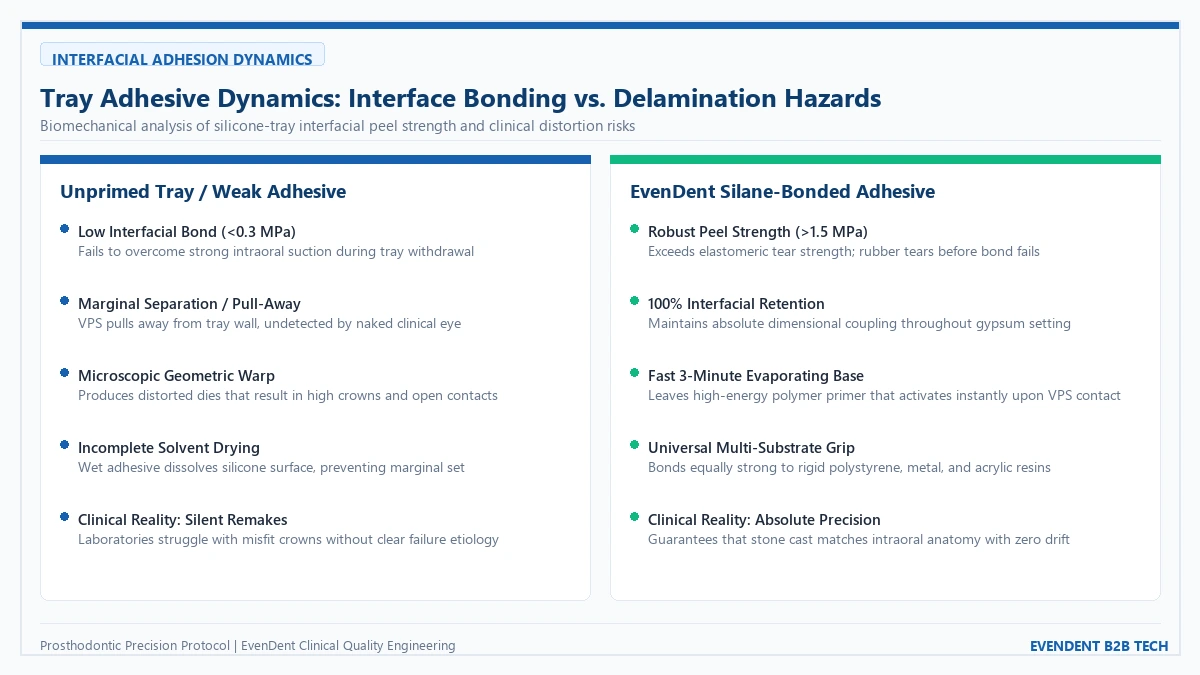
2. The 3-Minute Drying Kinetic Rule: Avoiding Solvent Trapping
The single most common clinical error in tray preparation is loading silicone before the adhesive has fully dried:
* The Incomplete Drying Hazard: If wet adhesive is entrapped beneath silicone, residual liquid solvent chemically dissolves the platinum catalyst at the impression interface. The result is a sticky, unpolymerized layer of “goo” along the tray wall that provides zero retention.
* The Golden Window: Apply a thin, uniform coat of adhesive at least 3 to 5 minutes prior to impression taking. A properly dried adhesive layer appears matte or slightly satin; it should feel tacky to a gloved touch without transferring wet liquid onto the glove.
3. Physical Performance Matrix: Peel & Shear Adhesion
Evaluated across multiple impression tray substrates under ISO 4823 bond strength protocols:
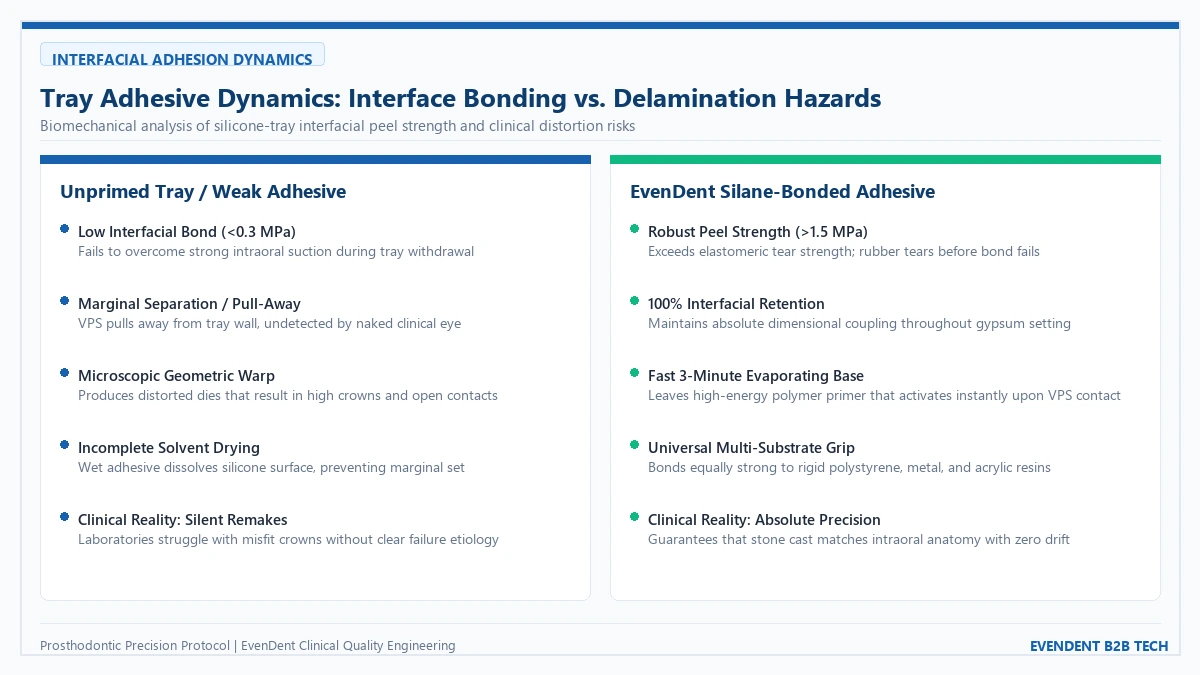
| Tray Substrate Material | Adhesive Formulation | Interfacial Peel Strength | Failure Mode Observed | Clinical Reliability |
|---|---|---|---|---|
| Rigid Polystyrene Plastic | EvenDent Silane Adhesive | > 1.6 MPa (High Grip) | Cohesive (Silicone rubber tears) | 100% Reliable |
| Plastic-Steel Composite | EvenDent Silane Adhesive | > 1.8 MPa (Maximum) | Cohesive rubber tear | Gold Standard |
| Perforated Metal Tray | EvenDent Silane Adhesive | > 1.5 MPa | Cohesive rubber tear | Recommended |
| Rigid Plastic Tray | Generic Low-Tack Adhesive | 0.35 – 0.50 MPa | Adhesive peel (Separates cleanly) | High Distortion Risk |
| Perforated Plastic Tray | No Adhesive (Perforations Only) | 0.15 – 0.25 MPa | Pulls through holes under suction | Unacceptable for C&B |
4. Clinical Protocol for Flawless Tray Retention
- Substrate Cleaning: Ensure the impression tray is dry and free of surface dust or operatory oils.
- Uniform Thin Coating: Using the integrated applicator brush, paint a thin, continuous layer across the entire internal surface of the tray, extending over the peripheral borders by 2 to 3 mm. Avoid pooling adhesive in deep palate or ridge depressions.
- Dedicated 3-Minute Evaporation: Allow full solvent evaporation. If in high-humidity operatory conditions, use a gentle stream of clean, oil-free compressed air for 15 seconds to accelerate drying.
- Load Silicone Promptly: Once dry, load VPS impression material within 30 minutes to maximize chemical radical affinity.
 English
 Español
 Português
 Français
 Italiano
 Deutsch
 Русский
 日本語
 한국어
 العربية