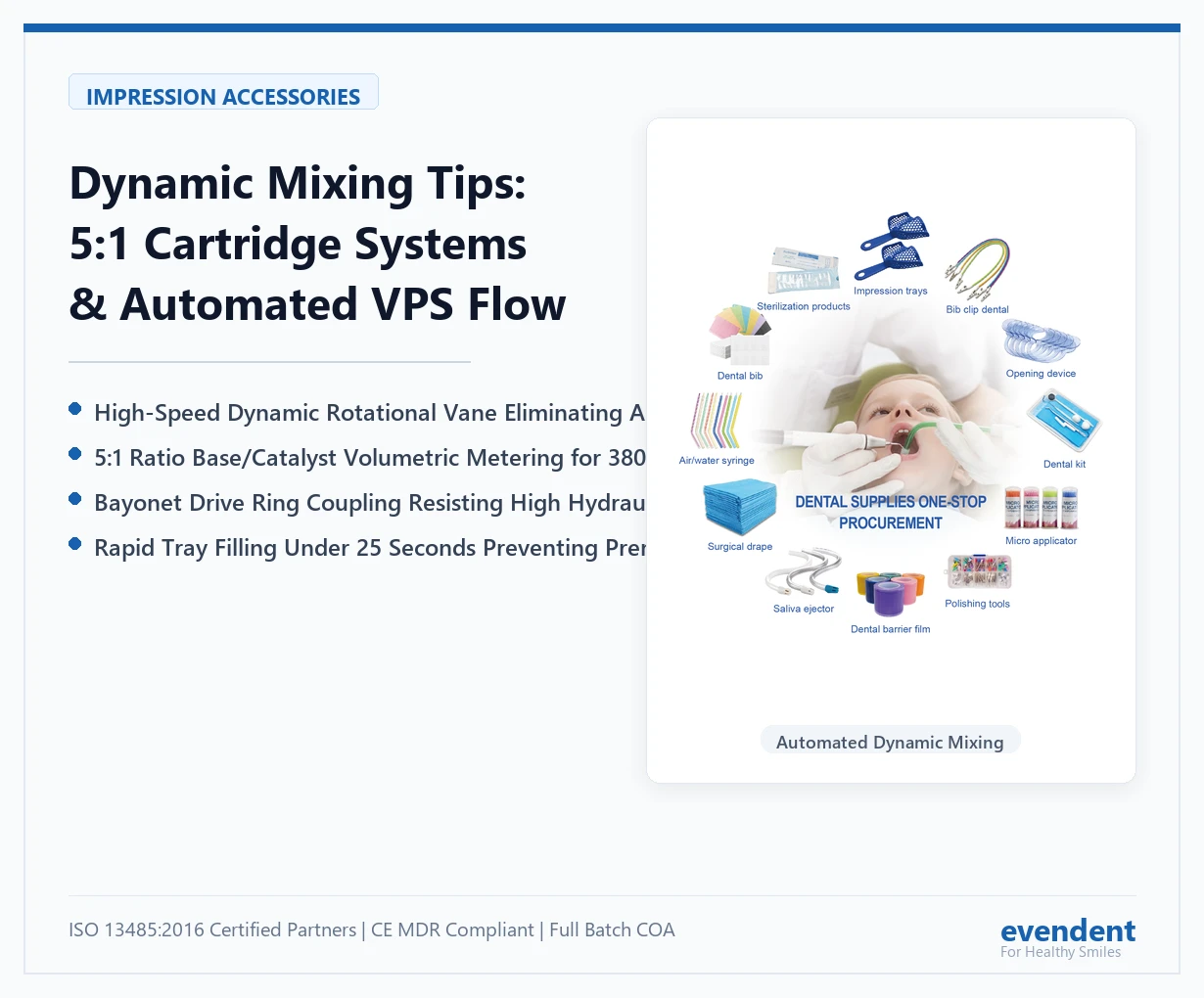

In high-volume prosthodontic clinics and dental laboratories, taking full-arch impressions using manual 50 mL hand-dispensing guns can be labor-intensive and slow. Automated impression mixing machines (such as Pentamix-compatible systems) utilize motorized planetary drives to dispense high-viscosity Addition Silicone (VPS) and polyether materials from large 380 mL (5:1 ratio) foil sausage packs or rigid cartridges.
The centerpiece of this automated workflow is the Dynamic Mixing Tip, which integrates internal high-velocity rotational shear to produce bubble-free, homogenous impression paste in seconds.
1. Fluid Dynamics: Static Helical Baffle vs. Dynamic Motorized Shear
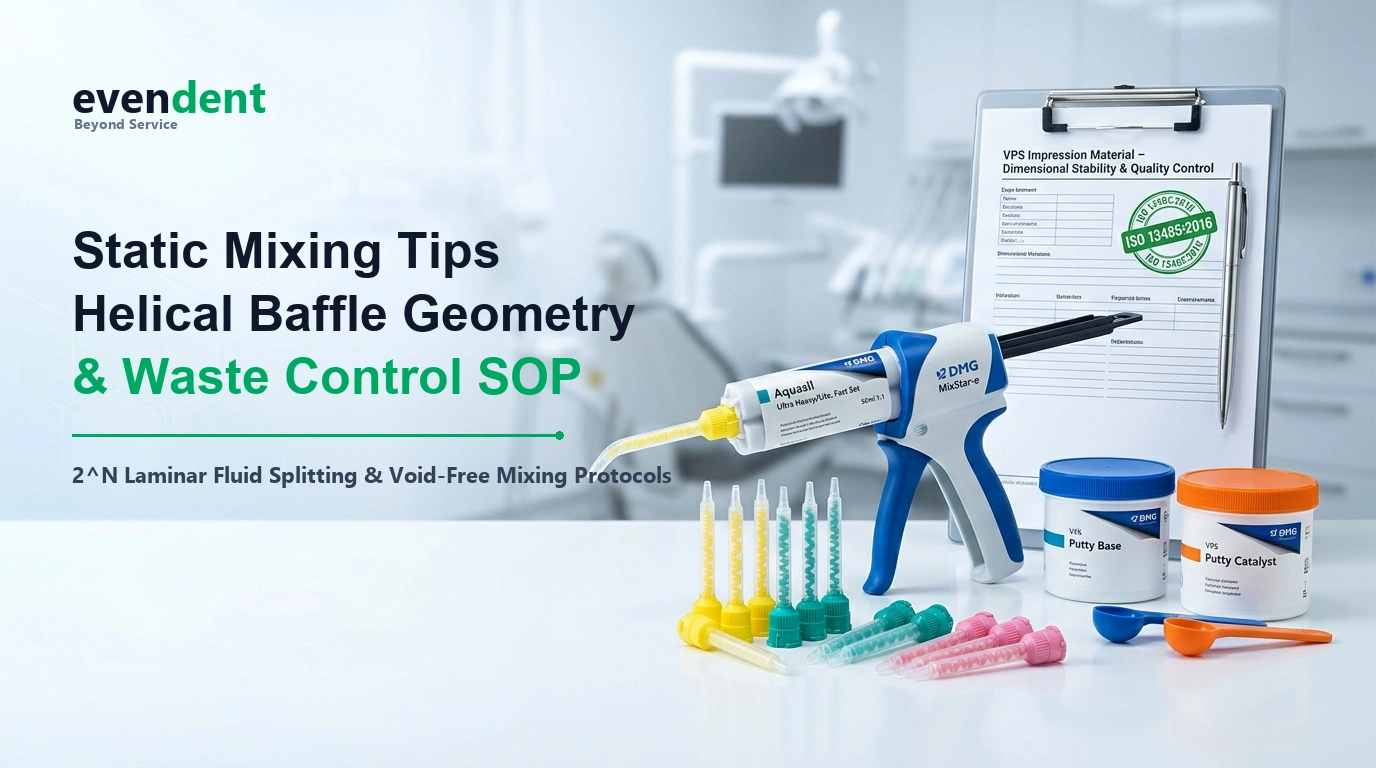
Manual automix cartridges rely on static mixing tips, where material is repeatedly split and recombined through 12 to 16 stationary helical elements. However, high-viscosity putty and heavy-body tray materials encounter massive flow resistance through static tips:
The Dynamic Rotational Vane Architecture
- Rotational Impeller: Unlike passive baffles, dynamic mixing tips contain a motorized internal rotor driven by the machine’s central drive shaft at approx. 1,000 to 1,500 RPM.
- Active Centrifugal Shearing: As the 5:1 Base (large cylinder) and Catalyst (small cylinder) are pushed into the chamber, the spinning blades subject the viscous silicone to intense shear forces.
- Entrapped Air Elimination: Centrifugal motion drives the heavier silicone mass against the mixing chamber walls while forcing microscopic air pockets out of the flow stream, delivering void-free paste.
- Reduced Plunger Back-Pressure: Active rotation fluidizes the silicone through thixotropic shear-thinning, dramatically lowering the hydraulic forward thrust required from the machine motor.
2. 5:1 Volumetric Ratio Metering and Cartridge Alignment
Automated impression systems operate on an asymmetrical 5:1 volumetric mixing ratio (5 parts Base paste to 1 part Catalyst reactor):
+------------------------------------------------------------------------+
|               5:1 DYNAMIC MIXING FLUID METRIC INTERFACE                |
+------------------------------------------------------------------------+
| Base Cylinder (317 mL)     ====> [ Large Port (83.3% Vol) ]           |
|                                         |                             |
|                                  [ ROTATING VANE ] ==> Uniform Extrusion|
|                                         |                             |
| Catalyst Cylinder (63 mL)  ====> [ Small Port (16.7% Vol) ]           |
+------------------------------------------------------------------------+
Critical Machine Interface Features
- Bayonet Drive Ring: The dynamic tip features a reinforced bayonet collar (typically Yellow or White drive hex ring) that locks firmly into the machine’s rotating drive axle. Any slippage strips the tip hex and halts mixing.
- Separate Inflow Orifices: Distinct inlet ports prevent cross-contamination between Base and Catalyst prior to reaching the active shearing chamber, eliminating premature clogging at the cartridge nozzles.
- Pressure-Resistant Outer Shell: Molded from high-density polypropylene (PP) to withstand dynamic internal operating pressures exceeding 3.5 MPa without ballooning or seam rupture.
3. Technical Comparison: Dynamic Machine Mixing vs. Manual Hand-Gun Mixing
| Operational Metric | 5:1 Dynamic Mixing Machine | 1:1 / 2:1 Manual Hand Gun | Clinical & Financial Benefit |
|---|---|---|---|
| Tray Loading Speed | 15 – 25 seconds | 50 – 75 seconds | Maximizes usable intraoral working time |
| Silicone Homogeneity | 100% streak-free, void-free | Occasional base/catalyst streaks | Eliminates soft, unpolymerized spots on trays |
| Material Wastage | Minimal (leaves small tip plug) | High per cartridge change | Lower overall cost per full-arch impression |
| Clinician Physical Fatigue | Zero (push-button automatic) | High manual hand-squeeze force | Ergonomic relief for clinical assistants |
| Cartridge Capacity | 380 mL (High Volume) | 50 mL (Frequent changes) | Ideal for busy multi-chair DSO practices |
4. Clinical Protocol: Machine Bleeding and Rapid Tray Loading
To ensure absolute impression fidelity when operating automated dynamic mixing systems:
- Step 1: Preliminary Nozzle Inspection & Purge:
- Before attaching a new dynamic tip, inspect the cartridge orifice.
- If installing a fresh 380 mL pack, express a small pea-sized amount directly from the machine nozzles without a tip to verify that both Base and Catalyst are extruding simultaneously.
- Step 2: Bayonet Tip Engagement:
- Align the dynamic tip with the cartridge ports and slide the drive hex ring into the machine’s rotating socket.
- Turn the locking lever or collar into the locked position until an audible click confirms engagement.
- Step 3: Continuous Tray Fill:
- Position the impression tray directly beneath the dispensing nozzle.
- Depress the fill button; keep the tip submerged beneath the rising surface of the silicone paste to avoid trapping surface air.
- Fill a full-arch rigid tray in under 20 seconds, then immediately seat intraorally within the material’s stated working time.
5. Wholesale Sourcing & Compatibility Standards
When procuring dynamic mixing tips in commercial volumes:
- Universal Compatibility: Designed to fit industry-standard automatic mixing machines (Pentamix 2, Pentamix 3, and equivalent 5:1 dynamic dispensing units).
- Packaging Formats: 50 pcs per bag, 500 pcs per master carton; available with matching yellow/white drive rings and bayonet retaining nuts.
- Quality Assurance: Sourced from certified facilities operating under ISO 13485:2016 quality management systems with CE Class I compliance, ensuring dimensional tolerances under ± 0.02 ext{ mm} for leak-free high-pressure operation.
Related EvenDent Products & Guides:
– Products: mixing tips – full range in the Dental Instruments category hub.
– Further Reading: mixing tips & dispensing guns guide.


 English
 Español
 Português
 Français
 Italiano
 Deutsch
 Русский
 日本語
 한국어
 العربية