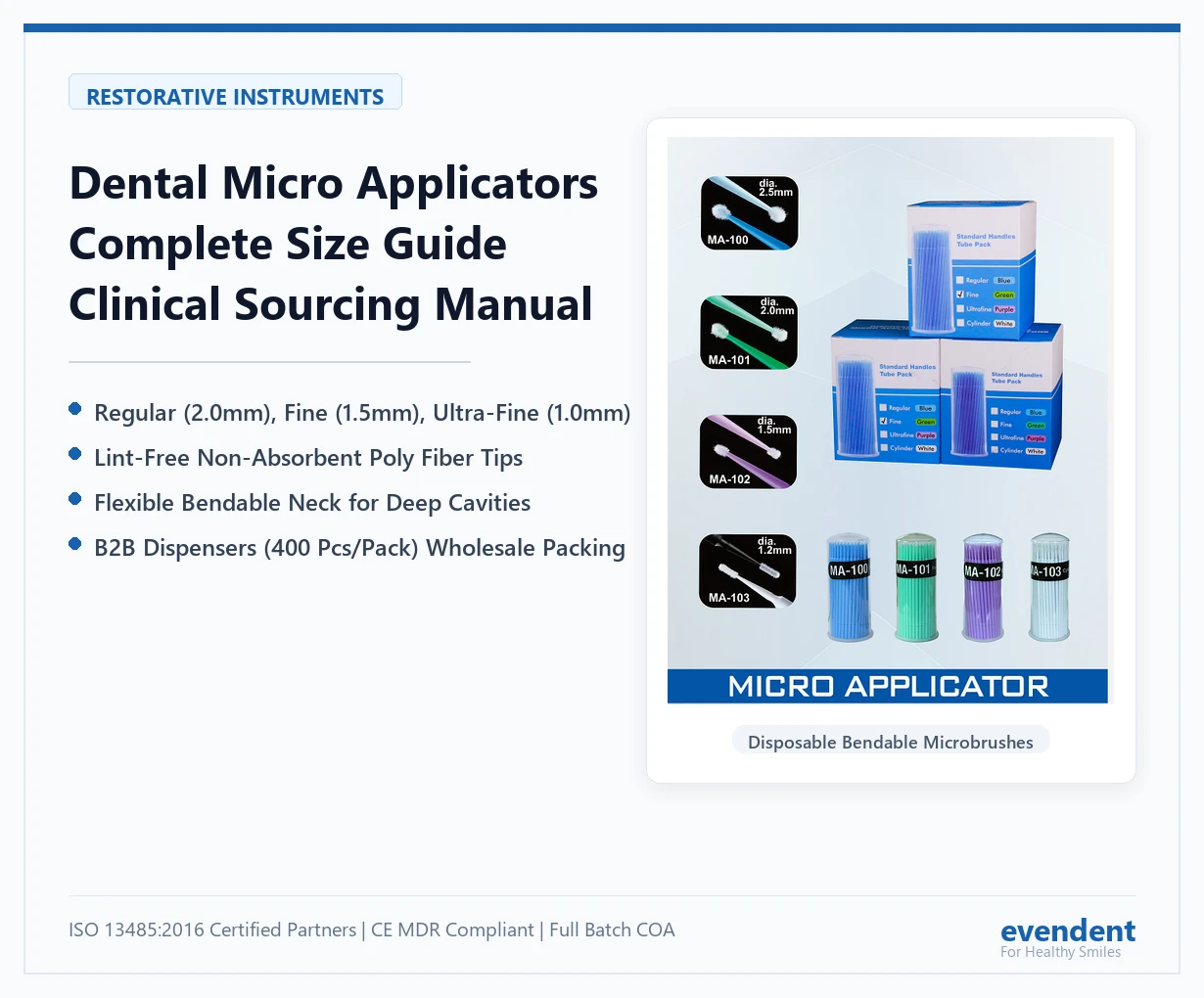

In daily operative dentistry, precision fluid placement in microscopic cavities is a constant necessity. Whether applying universal adhesives, $37\%$ phosphoric acid etch, desensitizing varnishes, hemostatic agents, or silane coupling primers, clinicians require an instrument that can reach restricted preparation angles without contaminating adjacent enamel.
While conventional cotton pellets and foam sponges were once common, they present severe clinical drawbacks: excessive liquid absorption that wastes expensive adhesive resins, lint shedding that contaminates restoration interfaces, and poor tactile access in narrow cavity boxes.
Modern disposable dental micro applicators (micro brushes) have solved these challenges through non-linting fiber head technology and bendable memory necks.
However, selecting the correct tip diameter ($2.5\text{ mm}$, $2.0\text{ mm}$, $1.5\text{ mm}$, or $1.2\text{ mm}$) and understanding international color-coding conventions are vital for efficient clinical operation and inventory management.
This comprehensive guide examines tip geometry, material science, clinical selection matrices, and bulk container purchasing protocols for dental practices, teaching hospitals, and medical distributors.
1. Material Science: Non-Linting & Non-Absorbent Fiber Technology
The primary function of a micro applicator is suspension, not absorption.
[Conventional Cotton Pellet]   ───► Absorbs liquid INTO its core (wastes 60% - 80% of resin)
[Engineered Micro Applicator]  ───► Suspends liquid BETWEEN micro-fibers (releases 90%+ on contact)
1.1 Spherical Non-Absorbent Synthetic Fibers
A premium micro applicator head consists of thousands of microscopic, non-linting synthetic fibers attached to a rigid polypropylene handle using heat-fusion (rather than chemical glues that can dissolve in acetone or ethanol-based bonding solvents).
* Capillary Fluid Suspension: Liquid is held purely by capillary action in the microscopic spaces between individual fiber filaments.
* Controlled Drop Release: When the tip contacts the prepared tooth dentin or enamel wall, the surface tension breaks immediately, transferring over $90\%$ of the liquid directly onto the target surface.
* Zero Fiber Shedding: Unlike cotton, the filaments will not detach or become embedded in the unpolymerized hybrid layer, preventing bond failures and microleakage.
1.2 Bendable Neck with Elastic Memory
The neck of the applicator is engineered with a localized plastic hinge. Clinicians can bend the head up to $90^\circ$ in any direction with finger pressure. A high-quality applicator maintains its bent angle without rebounding or snapping, granting effortless access to distal margins of second molars and narrow endodontic access cavities.
2. Tip Size & Color-Coding Selection Matrix
To prevent operatory cross-contamination and allow instant visual recognition, micro applicators adhere to standard size and color-coding classifications:
| Head Size Class | Approximate Tip Diameter | Standard Color Coding | Liquid Viscosity Compatibility | Primary Clinical Indication |
|---|---|---|---|---|
| Regular | $2.5\text{ mm}$ | Blue, Green, Orange | Medium-to-High Viscosity (Etchants, Sealants, Fluoride) | Large Class I & II cavity preps; full-surface enamel phosphoric acid etching; pit & fissure sealants. |
| Fine | $2.0\text{ mm}$ | Yellow, Purple, Dark Pink | Low-to-Medium Viscosity (Bonding agents, Desensitizers) | Routine Class II, III, & V composite restorations; dentin bonding agents; cervical wear desensitization. |
| Super Fine | $1.5\text{ mm}$ | White, Light Grey, Peach | Low Viscosity (Primers, Silane, Bleaching liquids) | Micro-cavities, veneer margin priming, interproximal margins, core build-up post channels. |
| Cylinder / Ultra-Fine | $1.2\text{ mm}$ | Black, Violet | Ultra-Thin Liquids & Canal Sealers | Deep endodontic canal orifices, narrow implant screw access channels, localized pinholes. |
3. Clinical Application Breakdown by Procedure
3.1 Dental Adhesive & Bonding Application
Applying universal dentin bonding agents requires active scrubbing into the collagen network for 20 seconds.
* Recommended Size: Fine ($2.0\text{ mm}$) or Super Fine ($1.5\text{ mm}$).
* Benefit: The dense fiber cluster withstands aggressive mechanical agitating against the cavity floor without splaying or shedding fibers.
3.2 Phosphoric Acid Enamel Etching
When applying $37\%$ phosphoric acid gel to enamel margins:
* Recommended Size: Regular ($2.5\text{ mm}$).
* Benefit: Carries an adequate bolus of gel in a single dip, speeding up isolation workflows and allowing precise margin boundary placement without spilling onto adjacent gum tissues.
3.3 Ceramic & Zirconia Primer (Silane Application)
Indirect porcelain veneers and ceramic inlays require micro-thin coatings of silane coupling agents.
* Recommended Size: Super Fine ($1.5\text{ mm}$).
* Benefit: Prevents excessive solvent pooling in delicate veneer intaglio surfaces, which can otherwise weaken composite resin cement polymerization.
4. Dispenser Options & Infection Control
Hygienic storage and single-unit dispensing are essential in modern operatories to comply with strict infection-control standards.
- Shake-and-Dispense Flip-Top Tumbler Bottles:
- Contains 100 applicators per transparent plastic tube.
- Features a specialized funnel cap: tilting and shaking the bottle drops a single applicator handle-first out of the orifice, eliminating the risk of clinician gloves contaminating the remaining tips inside the bottle.
- Push-Button Mechanical Dispensers:
- A weighted desktop dispenser where pushing a front lever feeds a single micro applicator onto a sterile tray.
- Sealed Polybag Refills:
- Designed for high-volume hospital clinics seeking minimal plastic packaging waste.
5. Wholesale Sourcing & Container Logistics
For medical distributors and dental depot wholesalers, micro applicators offer high commercial margins with minimal shipping weight:
- Inner Packaging: 100 applicators per plastic tube; 4 tubes per commercial display box = 400 applicators per box.
- Master Export Cartons: 32 display boxes per master carton = 12,800 applicators per carton ($48 \times 38 \times 35\text{ cm}$, gross weight approx. $8.5\text{ kg}$).
- Container Shipping Advantage: Because micro applicators are lightweight and compact, they serve as the ideal container filler. Consolidating micro applicator cartons on top of heavy palletized goods—such as Dental Stone (Type IV) or Alginate Impression Materials—allows distributors to fully utilize empty container height without exceeding road weight restrictions.
- Regulatory Compliance: Manufactured under ISO 13485 medical quality management systems, complete with CE Class I compliance and non-hazardous transport declarations.
Summary Sourcing Checklist for Dental Depots
- Verify Heat-Fused Fibers: Ensure filaments are heat-welded, not glued with solvent-soluble adhesives.
- Test Neck Plastic Memory: Confirm the applicator neck bends smoothly to $90^\circ$ without snapping or spring-back.
- Stock the Big Three Sizes: A balanced distributor inventory consists of $50\%$ Fine ($2.0\text{mm}$), $30\%$ Regular ($2.5\text{mm}$), and $20\%$ Super Fine ($1.5\text{mm}$).
- Leverage Multi-Category Mixed Shipments: Combine micro applicators with Dental Bibs and Mixing Tips to minimize per-unit ocean freight charges.
Partner with EvenDent for Your Dental Consumables Supply
At EvenDent, we supply worldwide dental distributors, clinics, and hospital networks with dependable, clinic-proven dental consumables.
- Superior Fluid Suspension: Non-absorbent, lint-free fibers bonded to robust polypropylene shafts.
- Full Range of Sizes: Complete inventory of Regular ($2.5\text{mm}$), Fine ($2.0\text{mm}$), Super Fine ($1.5\text{mm}$), and Cylinder tips in full ISO color palettes.
- Flexible Packaging & OEM: 100-piece flip-top tubes, 4-tube inner display boxes, and private-label OEM branding options.
Streamline your clinic consumables procurement:
- 👉 Request Free Product Samples & Wholesale Price Sheets
- Explore Our Complete Line: View our Oral Consumables Category Hub or connect with our export team via WhatsApp at +86 180 1638 1172.
Frequently Asked Questions (FAQ)
Q1: Can dental micro applicators be sterilized and reused?
A: No. Micro applicators are strictly single-use disposables. The fine synthetic fibers retain microscopic chemical residues that cannot be washed clean, and exposure to autoclave heat ($121^\circ\text{C} – 134^\circ\text{C}$) will melt the polypropylene handle and hinge.
Q2: Why are different colored micro applicators used in the same clinic?
A: Clinicians use distinct colors to track different chemicals chairside. For instance, using a green applicator for phosphoric acid etch and a yellow applicator for bonding resin prevents cross-contaminating chemical bottles or confusing agents during multi-step restorative procedures.
Q3: What is the shelf life of disposable micro applicators?
A: When stored in closed tubes away from excessive heat and direct sunlight, micro applicators have an indefinite shelf life (typically warrantied for 5 years).
 English
  Español
  Português
  Français
  Italiano
  Deutsch
  Русский
  日本語
日本語  한국어
한국어  العربية