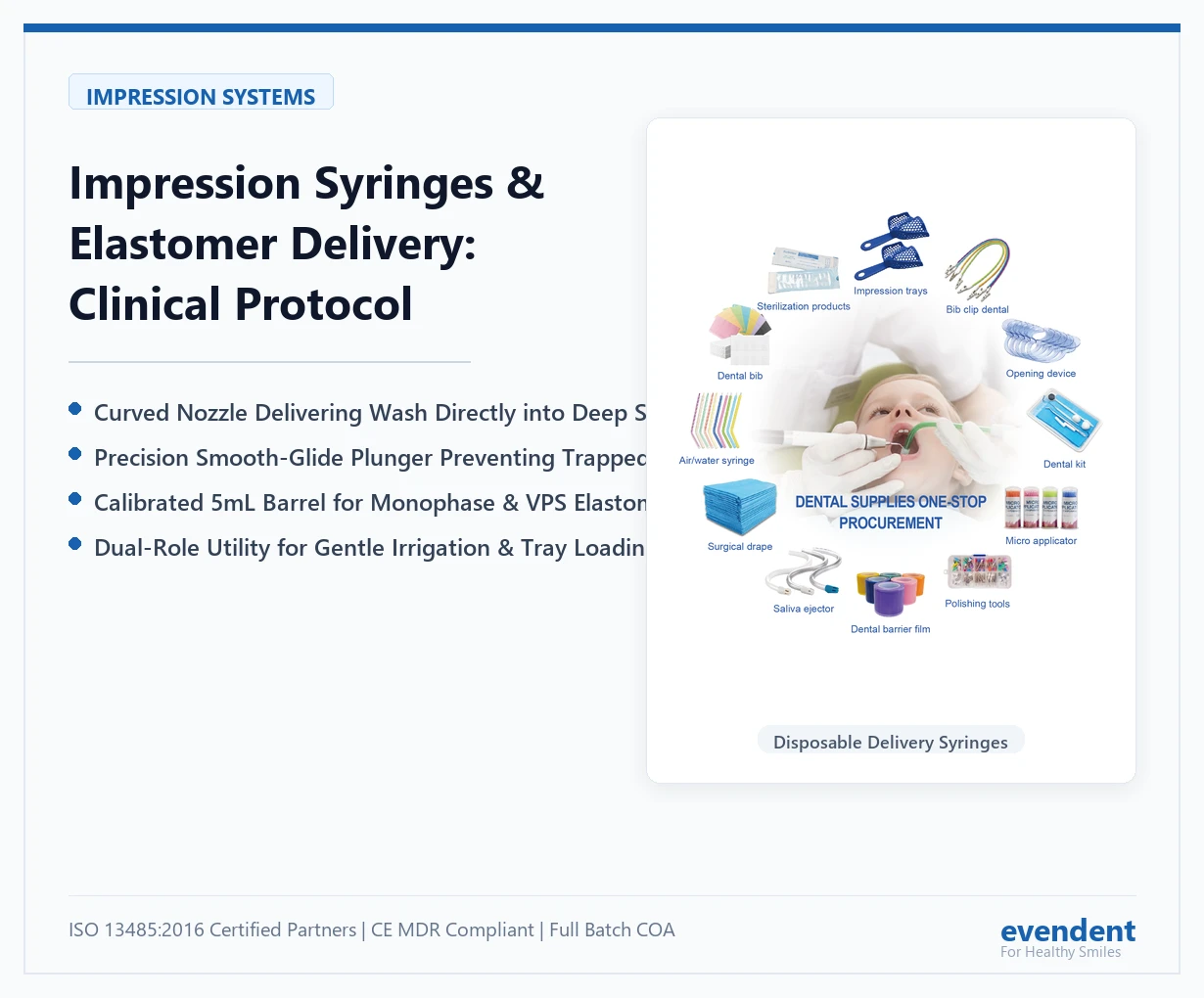

Capturing an exact, distortion-free negative replica of subgingival finish lines during crown and bridge preparation requires fluid control of light-body elastomer wash materials. While automated dispensing guns and dynamic mixing tips provide convenient material extrusion, specialized curved dental impression syringes remain indispensable for delivering wash materials precisely into deep, narrow sulcular spaces without trapping micro-bubbles.
This technical guide provides restorative clinicians, prosthodontic specialists, and dental procurement managers with an analysis of syringe barrel mechanics, plunger seal dynamics, elastomer handling protocols, and bulk supply standards.
1. Mechanical Anatomy: Curved Tip Syringes vs. Automix Intraoral Tips
Clinical wash delivery relies on fluid hydrodynamic displacement around prepared tooth margins:
Curved Plastic Utility & Impression Syringes (5 mL to 12 mL)
- Curved Tapered Nozzle: Features a 30° to 45° pre-curved tip that can be easily trimmed with surgical scissors to adjust the delivery orifice diameter from 1.0 mm (fine subgingival syringing) up to 2.5 mm (rapid heavy-body loading).
- Smooth-Glide Plunger: Utilizes a medical-grade silicone-free elastomer plunger tip that delivers smooth, non-ratcheting tactile feedback, preventing sudden bursts of material that trap air.
- Graduated Calibration: Laser-etched or molded volume markings (1 mL increments) allow clinicians to monitor remaining material volume chairside.
Clinical Utility Versatility
Beyond elastomer impressions, curved delivery syringes serve as versatile operatory workhorses:
* Gentle sulcular and socket irrigation with warm saline or chlorhexidine following extractions.
* Controlled dispensing of hydrocolloid, alginate wash, or periodontal dressing pastes.
* Precise placement of temporary crown acrylics and bite registration silicone.
2. Technical Comparison Matrix: Impression Delivery Instruments
| Instrument Format | Capacity / Volume | Orifice Diameter | Plunger Seal Material | Cleanliness Profile | Primary Clinical Indication |
|---|---|---|---|---|---|
| Disposable Curved Syringe (5 mL) | 5 mL (cc) | 1.0 – 1.8 mm (Trimmable) | Medical Elastomer (Latex-Free) | Clean Non-Sterile / Bulk Pack | Precision crown & bridge subgingival wash syringing |
| Disposable Curved Syringe (12 mL) | 12 mL (cc) | 1.5 – 2.5 mm (Trimmable) | Medical Elastomer (Latex-Free) | Clean Non-Sterile / Bulk Pack | Full-arch quadrant loading, post-op socket irrigation |
| Automix Intraoral Plastic Tips | Fits standard gun | 1.0 – 1.2 mm fixed | Driven by gun piston | Disposable Unit Tip | Direct wash delivery from 50 mL automix cartridges |
| Metal Autoclavable Syringe Body | 5 mL barrel | Interchangeable nozzles | Brass / O-ring piston | Reusable Steam Autoclave | Heavy polysulfide / polyether elastomer loading |
3. Clinical Step-by-Step Subgingival Delivery Protocol
Adhering to standardized syringing kinematics guarantees clean, bubble-free margin reproduction:
- Preparation and Tip Trimming:
- Trim the curved syringe nozzle at a 45° angle to create a smooth, oval 1.2 mm delivery orifice.
- Loading the Impression Material:
- Express mixed light-body Addition Silicone (VPS) or Polyether directly from the automix gun into the open back of the syringe barrel.
- Insert the plunger, invert the syringe with the tip pointed upward, and gently depress the plunger to vent all trapped air pockets out of the nozzle.
- Submerged Sulcular Syringing Kinematics:
- Position the syringe tip at the deepest aspect of the interproximal preparation margin.
- Begin steady, continuous extrusion while keeping the tip submerged beneath the advancing material pool.
- Advance continuously around the tooth circumference; never lift the nozzle out of the material stream to prevent air entrapment along the finish line.
- Air-Blow Technique:
- Use a gentle puff of dry air from the air-water syringe to push the low-viscosity wash deep into the opened gingival sulcus, then immediately apply a second wash layer before seating the heavy-body tray.
4. Manufacturing Quality & Global Supply Chain Auditing
When ordering disposable impression syringes in volume (1,000 to 50,000 pcs per order):
- Plunger Seal Hermeticity: The rubber or TPE plunger must maintain an airtight seal without fluid blow-by under high extrusion pressure, even with viscous polyether materials.
- Medical-Grade Purity: Molded from virgin medical-grade polypropylene (PP) free from silicone lubricants or plasticizers that could inhibit addition-cure platinum catalysts.
- Carton Packaging: Heat-sealed transparent bags (50 pcs/bag, 10 to 20 bags per master export carton) with drop-tested corrugated outer cartons to prevent barrel crushing during sea transit.
- Compliance Documentation: Manufactured under ISO 13485:2016 quality systems, CE Class I registration, and complete lot traceability records.
Related EvenDent Products & Guides:
– Product Range: Browse the Impression Materials category hub.
– Further Reading: VPS impression material guide and impression materials selection guide.
 English
 Español
 Português
 Français
 Italiano
 Deutsch
 Русский
 日本語
 한국어
 العربية