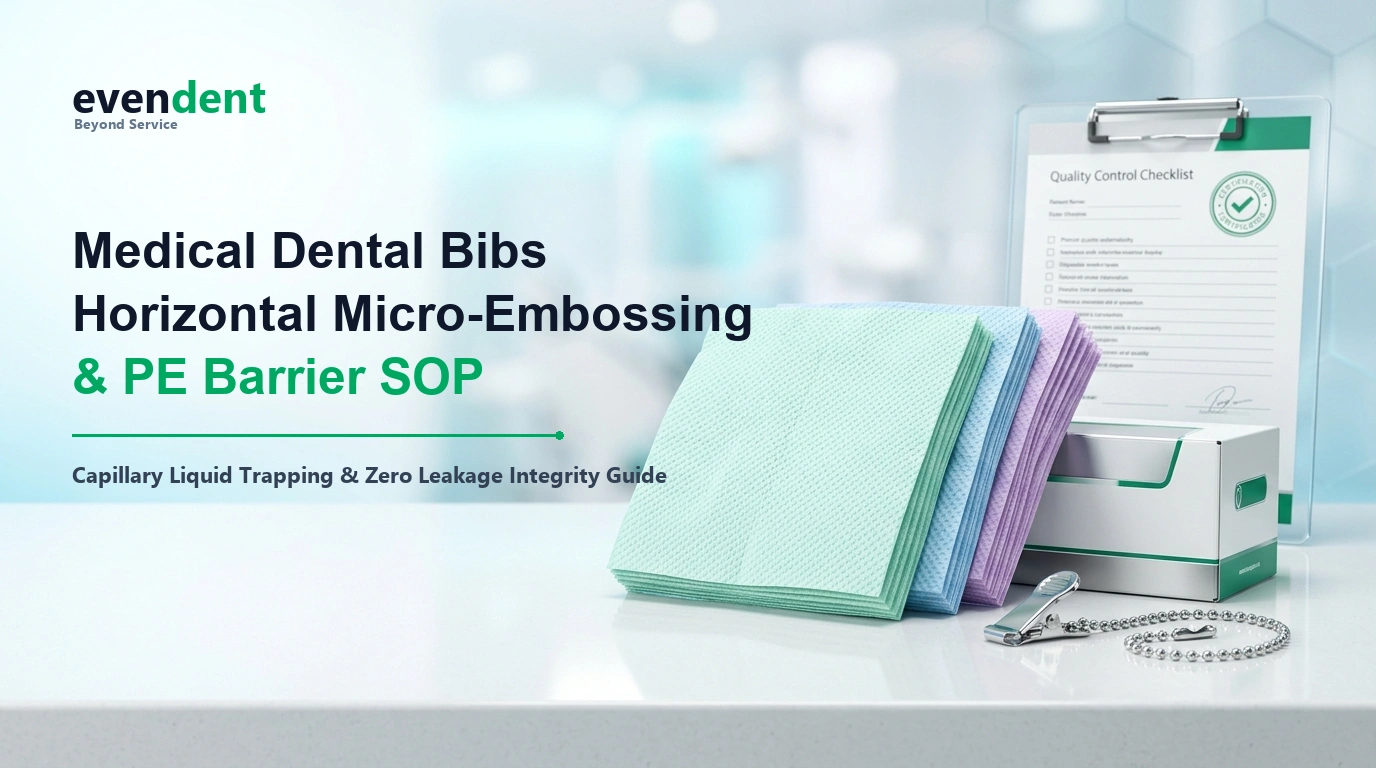

In the modern dental operatory, cross-contamination control and patient comfort represent non-negotiable standards of care. A patient seated in the dental chair is routinely exposed to high-velocity aerosols, ultrasonic cooling spray, caustic etchants (37% phosphoric acid), and blood droplets.
While often viewed as a simple disposable commodity, a professional-grade dental bib is an engineered multi-ply composite requiring precise balance between capillary absorbency and pinhole-free impermeable barrier protection. Substandard bibs with poor lamination or recycled paper fail rapidly, staining patient clothing and compromising clinical hygiene.
1. Multi-Ply Composite Architecture: 2-Ply Paper + 1-Ply PE
The gold standard in clinical practice is the 2-Ply + 1-Ply configuration:
+------------------------------------------------------------------------+
|                   MULTI-PLY BIB LAMINATION DYNAMICS                    |
+------------------------------------------------------------------------+
| Layer 1: Top Pure Virgin Woodpulp (16-18 GSM)                          |
| Micro-embossed grid -> Rapid 1.5s capillary absorption of water/saliva |
|                                                                        |
| Layer 2: Middle Pure Virgin Woodpulp (16-18 GSM)                       |
| High void ratio reservoir -> Lateral liquid dispersion & volume capture|
|                                                                        |
| Layer 3: Bottom Polyethylene Film (10-14 GSM)                          |
| Pinhole-free extruded PE -> 100% waterproof barrier against chemicals  |
| ===> Thermal fusion bonded: Zero delamination under heavy saturation   |
+------------------------------------------------------------------------+
Virgin Woodpulp vs. Recycled Fiber Performance
- 100% Virgin Bleached Kraft Pulp: Features long, interlocking cellulose fibers with intact capillary lumina. When aerosol mist strikes the surface, liquid is drawn into fiber walls within 1.5 seconds, preventing surface pooling and run-off.
- Recycled Paper Flaws: Recycled fibers are short, crushed, and contaminated with residual clays and binding resins. They exhibit sluggish absorption (>5 seconds), causing fluid to cascade off the bib onto the patient’s chest.


2. Embossing Geometry: Horizontal Waffle vs. Decorative Dimples
The embossing pattern on a dental bib is not decorative; it serves a vital mechanical function:
| Embossing Pattern | Capillary Dispersion Rate | Liquid Run-Off Resistance | Wet Delamination Resistance | Tactile Softness |
|---|---|---|---|---|
| EvenDent Horizontal Waffle Grid | Ultra-Fast (< 1.5s) | High (Micro-dams trap liquid) | High (Zero ply peeling) | Plush & Pliable |
| Random Diamond Dimpling | Medium (3.0s) | Medium (Channels fluid sideways) | Medium | Moderate |
| Flat / Shallow Stamped | Sluggish (> 5.0s) | Poor (Liquid sheets off bib) | Low (Separates into layers) | Stiff & Crinkly |
| Unembossed Smooth Surface | Very Poor (> 8.0s) | Complete failure | Immediate delamination | Rigid paperboard |
The “Micro-Dam” Fluid Control Mechanism
EvenDent’s proprietary horizontal waffle embossing compresses cellulose fibers into raised ridges interspersed with recessed cells. These micro-embossed cells function as microscopic retention dams. When a sudden burst of water hits the bib, the ridges arrest the fluid velocity while the floor of each cell rapidly wicks the moisture downward into the secondary absorbent ply.
3. Barrier Integrity: Low-Tack Solvent-Free Thermal Lamination
The critical interface is the bond between the bottom paper ply and the polyethylene (PE) backing:
* Solvent Adhesives Hazard: Older manufacturing techniques used solvent-based glues, which emit volatile organic compounds (VOCs) that irritate patient airways and can break down when exposed to alcohol-based surface disinfectants.
* Advanced Thermal Extrusion Fusion: EvenDent employs state-of-the-art thermal lamination. Molten PE film is extruded directly onto the virgin pulp sheet under calibrated heated rollers. This forms a permanent mechanical-chemical interlock between cellulose fibers and the polymer film, guaranteeing zero delamination even when saturated with irrigation fluids.
4. Tensile Tear Strength & Neck Chain Ergonomics
A frequent complaint from dental assistants is bibs tearing around the neck clips during treatment:
* Corner Tear Resistance: During lengthy restorative procedures, patient head movement exerts lateral tension on dental bib clips. EvenDent bibs feature reinforced edge embossing that resists over 12 Newtons of tensile pulling force, preventing clip pull-out.
* Standard B2B Sizing: Precision cut to 13″ x 18″ (33 cm x 45 cm) with an ergonomic neck cutout, providing complete chest and shoulder coverage without bunching up under the patient’s chin.
* Packaging Hygiene: Shipped in heavy-duty 500-count cartons (125 bibs per inner polybag, 4 bags per export master carton), protected against warehouse dust and moisture.


 English
 Español
 Português
 Français
 Italiano
 Deutsch
 Русский
 日本語
 한국어
 العربية