
In preventive dentistry, routine periodontal maintenance, and pre-bonding tooth preparation, coronal polishing is performed millions of times each day worldwide. The goal of prophylaxis is twofold: thoroughly remove extrinsic dental stains and bacterial plaque while preserving hard enamel and avoiding irritation to delicate marginal gingiva.
However, polishing involves continuous rotary friction against enamel and exposed root dentin. Utilizing low-quality, rigid prophy cups can generate excessive centrifugal paste splatter, micro-scratches on restorative materials, and hazardous friction heat capable of causing irreversible pulpal thermal injury.
Understanding prophy cup internal geometry and elastomeric material properties allows dental teams to maximize cleaning efficiency while safeguarding patient safety.
1. Centrifugal Dynamics: Ribbed vs. Webbed Internal Geometry
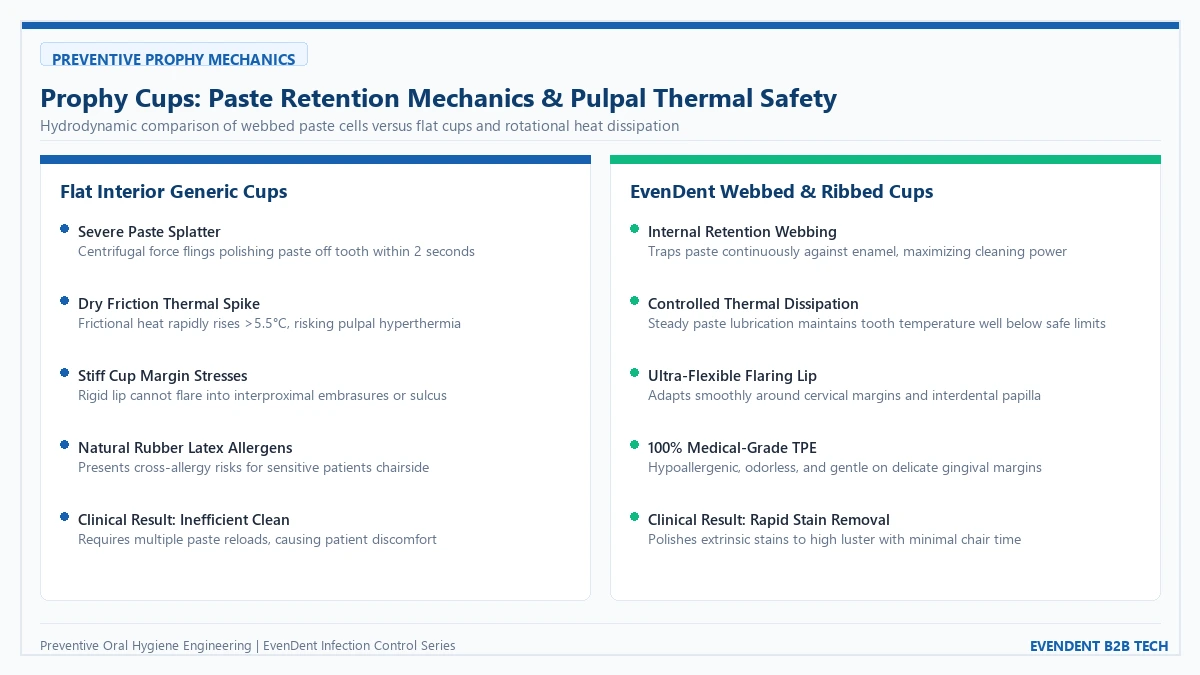
When a prophy cup rotates against a tooth at 1,500 to 2,500 RPM, severe centrifugal force drives prophylaxis paste outward toward the rim:
+------------------------------------------------------------------------+
|                   ROTARY PROPHY PASTE CENTRIFUGAL DYNAMICS             |
+------------------------------------------------------------------------+
| Flat Smooth Interior Cup:                                              |
| No internal barriers -> Centrifugal force flings paste off rim         |
| ---> Splatters across lips, mirror, and operatory within 2 seconds     |
| ===> Cup runs dry; Excessive dry friction spikes surface temperature   |
|                                                                        |
| EvenDent Webbed & Ribbed Interior Cup:                                 |
| Radial internal ribs + Intersecting webbed pocket cells                |
| ---> Locks paste continuously within the cup lumen during rotation     |
| ===> Steady fluid paste feed against enamel with ZERO splatter         |
+------------------------------------------------------------------------+
Webbed vs. Spiral Ribbed Selection
- Webbed Cup Architecture: Features internal cellular dividers that form miniature fluid reservoirs. Ideal for high-efficiency stain removal on flat buccal and lingual surfaces of anterior and posterior teeth.
- Spiral Ribbed Architecture: Incorporates angled spiral channels that draw abrasive paste inward toward the center of the cup as it spins. Superior for polishing interproximal margins and tight interdental spaces.
2. Pulpal Thermal Safety: The 5.5°C Critical Threshold
Classic research in endodontic biology demonstrates that an intrapulpal temperature rise of merely 5.5°C (9.9°F) causes irreversible thermal necrosis in up to 15% of healthy dental pulps. An increase of 11°C leads to complete pulpal death:
| Operating Factor | High-Risk Operational Hazard | EvenDent Recommended Clinical Protocol |
|---|---|---|
| Rotational Handpiece Speed | Operating above 3,500 RPM (Burn hazard) | 1,500 – 2,500 RPM (Controlled low speed) |
| Contact Pressure | Heavy, continuous pressure (>200 grams) | Intermittent, light feather-touch (50-100g) |
| Dwell Time per Tooth | Holding cup stationary for > 5 seconds | Dynamic 2-to-3 second sweeping stroking motion |
| Paste Lubrication | Continuing to polish after paste runs dry | Reload paste as soon as lubricity decreases |
| Cup Material Durometer | Hard, stiff rubber (High friction) | Soft Medical TPE (Shore A 45 durometer) |
3. Material Chemistry: Medical TPE vs. Natural Rubber Latex
EvenDent manufactures disposable prophy cups exclusively from high-purity Thermoplastic Elastomer (TPE):
* 100% Latex-Free & Hypoallergenic: Eliminates the catastrophic risk of Type I latex allergic reactions, which can trigger anaphylaxis in sensitized patients and healthcare workers.
* Optimal Flare Flexibility (Shore A 45): Stiff cups resist bending, preventing the cup lip from adapting into the gingival sulcus. EvenDent TPE cups feature ultra-thin, highly elastic rims that flare smoothly under light pressure, sliding 1 to 2 mm subgingivally to clean sulcular margins without abrading soft tissue.
* Odor-Free & Taste-Neutral: Contains zero vulcanization sulfur chemicals, ensuring a pleasant, non-offensive chairside experience for pediatric and sensitive adult patients.
4. Handpiece Connection & Concentricity Calibration
Vibration and eccentricity in rotary angles cause hand fatigue for hygienists and noisy discomfort for patients:
* Standard Latch-Type (RA) Shank: Precision machined to ISO 1797 dimensions, fitting seamlessly into all standard low-speed dental handpiece contra-angles.
* Zero-Wobble Concentric Molding: EvenDent cups undergo 100% optical run-out inspection. The concentricity tolerance is held within ±0.02 mm, preventing erratic rhythmic thumping against tooth enamel even at maximum rated clinical speeds.
* Bulk Clinic Sourcing: Packaged in clean, hygienic 100-piece boxes and 1,000-piece master cases for institutional dental clinics and wholesale procurement.



 English
 Español
 Português
 Français
 Italiano
 Deutsch
 Русский
 日本語
 한국어
 العربية