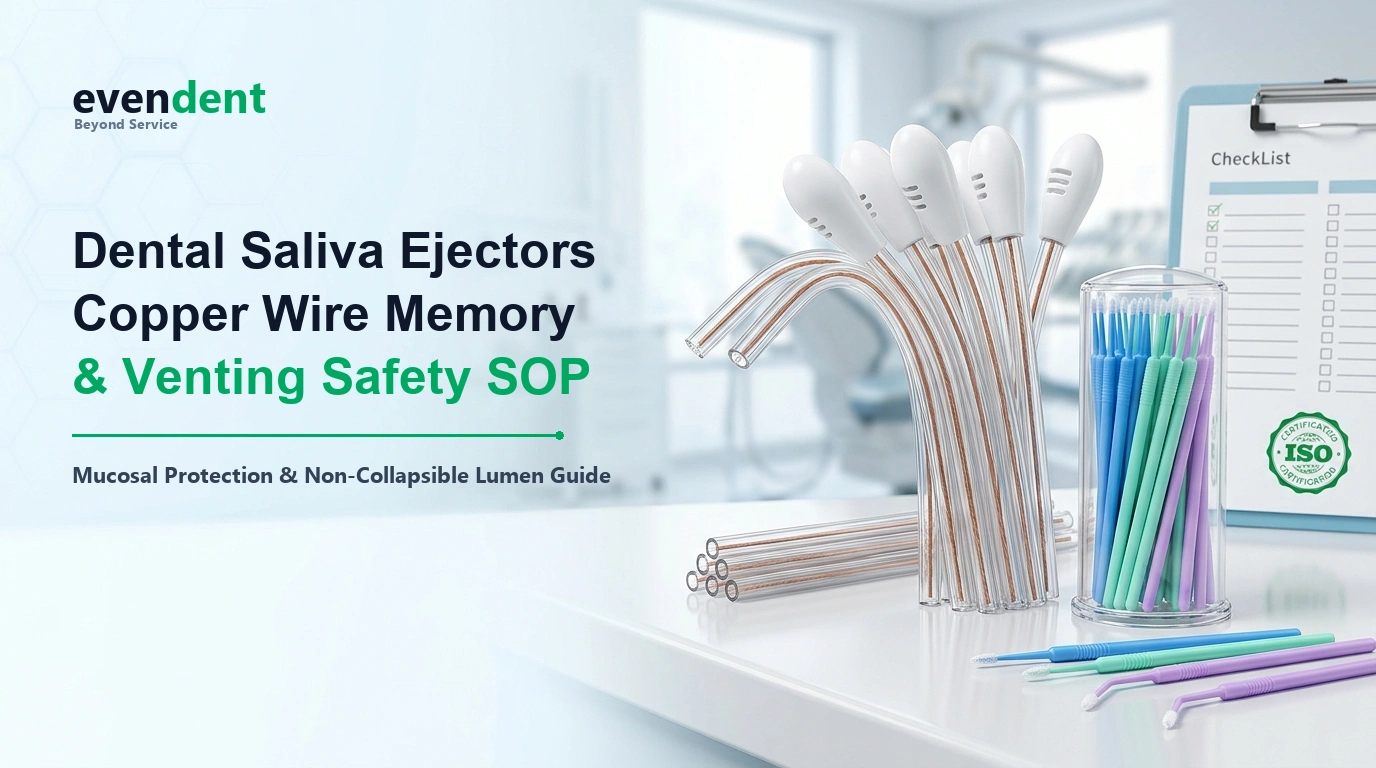

During operative dentistry, endodontic treatment, and ultrasonic scaling, maintaining a dry, saliva-free field is essential for adhesive resin bonding and clinical visibility. The disposable saliva ejector serves as the constant workhorse of low-volume evacuation (LVE).
Yet, dental practitioners frequently encounter two frustrating biomechanical failures with low-cost ejectors: elastic spring-back (where the bent tube gradually straightens out, popping out of the patient’s mouth) and mucosal grab (where high negative vacuum pressure sucks the soft floor of the mouth into the suction orifice, causing painful hematomas and tissue bruising).
Understanding the metallurgical properties of the internal wire core and the fluid dynamics of the suction tip reveals how engineering makes the difference.
1. Metallurgical Wire Memory: Annealed Copper vs. Spring Steel
The ability of a saliva ejector to maintain an anatomical curve around the dental arch depends entirely on the metallurgical composition of its embedded core wire:
+------------------------------------------------------------------------+
|                   SALIVA EJECTOR BENDING DYNAMICS                      |
+------------------------------------------------------------------------+
| Low-Grade Galvanized Iron / Steel Wire:                                |
| High elastic modulus & severe spring-back memory                       |
| ---> Bent at 180° ---> Springs back 35° within 5 minutes                |
| ===> Ejector displaces from floor of mouth; requires repeated re-bending|
|                                                                        |
| EvenDent Pure Annealed Copper Core:                                    |
| Low yield point & high plastic ductility                               |
| ---> Bent at 180° ---> 0° Spring-back; 100% anatomical retention        |
| ===> Remains stably locked in position throughout the entire procedure |
+------------------------------------------------------------------------+
The Annealing Advantage
During manufacturing, EvenDent subjects pure copper wire to controlled thermal annealing. This metallurgical process relieves internal crystalline stresses, transforming the wire into a dead-soft state:
* Effortless Contouring: Clinicians can mold the ejector into custom S-curves, J-hooks, or lingual retraction loops with minimal fingertip pressure.
* Zero Spring-Back: Once bent, the copper wire exhibits zero elastic rebound, keeping the ejector securely anchored against the buccal mucosa or floor of the mouth without popping out.
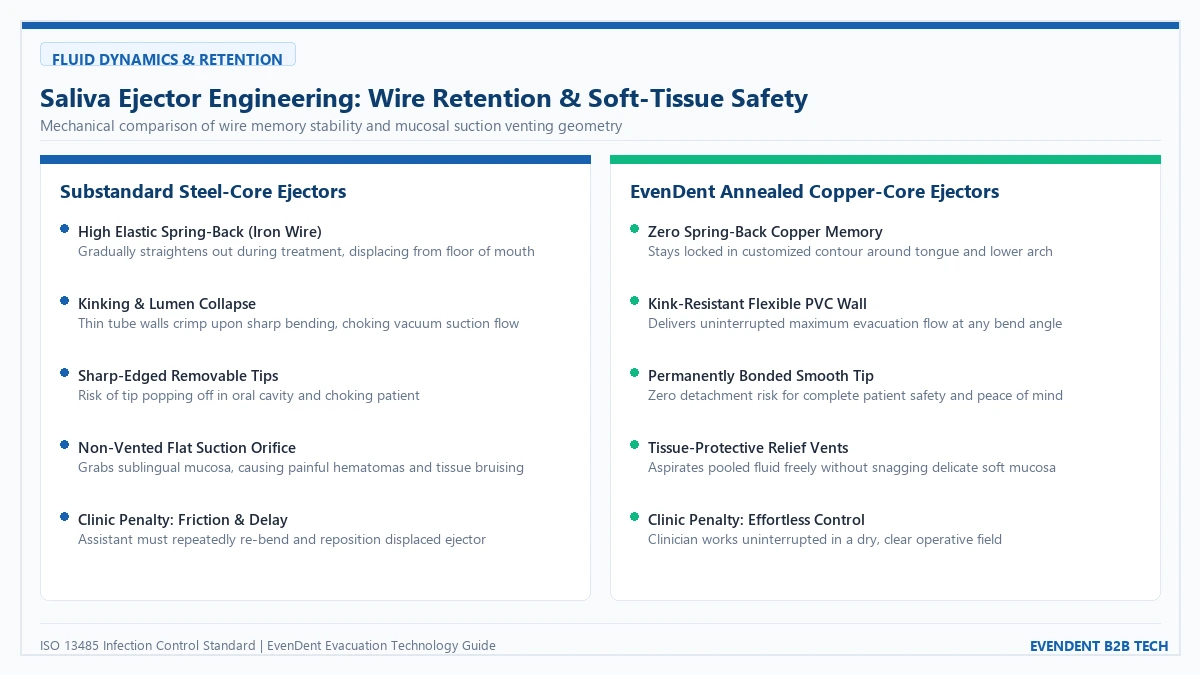

2. Tip Geometry: Cushion-Vent Flow Relief vs. Flat Orifice
The negative pressure generated by dental vacuum lines can reach -15 to -25 kPa. If an unvented suction tube contacts soft tissue, the entire vacuum force acts directly upon the delicate sublingual mucosa:
| Tip Engineering Trait | EvenDent Vented Cushion Tip | Flat Open Suction Tip | Removable Mesh Plug Tip |
|---|---|---|---|
| Soft Tissue Hematoma Risk | Zero (Lateral vents relieve vacuum) | High (Aggressive tissue grabbing) | Moderate (Mesh clogs with debris) |
| Continuous Fluid Aspiration | Uninterrupted (Bypass flow design) | Chokes whenever touching cheek | Flow slows as mesh accumulates saliva |
| Tip Detachment Safety | Permanently Molded (Zero separation) | Glued (Risk of aspiration) | Pops off under vacuum pressure |
| Lumen Kink Resistance | 100% Smooth Bore (Medical PVC) | Kinks and pinches shut | Pinches easily on acute bends |
| Tongue Retraction Support | Stable Lateral Retraction | Shifts and slips | Shifts and slips |
The Bypass Flow Mechanism
EvenDent’s proprietary non-removable tip features curved lateral relief apertures around the perimeter. If the distal apex of the tip touches oral soft tissue, the vacuum automatically draws ambient air and fluid through the open side vents. This immediately equalizes negative pressure, completely preventing tissue entrapment while continuously aspirating pooled saliva.
3. Medical-Grade PVC Formulation: Plasticizer & Kink Resistance
The clear flexible tubing surrounding the copper core is extruded from medical-grade virgin polyvinyl chloride (PVC):
* DEHP-Free Plasticizers: Contains non-toxic, biocompatible plasticizers meeting USP Class VI medical device standards. It emits zero plastic odors and will not leach chemical residues into oral fluids.
* Anti-Kink Lumen Stability: Engineered with optimal wall thickness (0.65 mm). Even when bent sharply at a 180-degree hairpin turn around the lower lip, the internal lumen retains an open cross-sectional diameter, preventing flow constriction and suction drop.
4. Cross-Infection Control & Backflow Prevention Protocols
Recent infection control guidelines published by the CDC and ADA highlight the phenomenon of suction line backflow:
* The Backflow Hazard: When a patient closes their lips tightly around a saliva ejector tip (creating a seal), the pressure inside the patient’s mouth can momentarily drop below the pressure in the dental unit’s evacuation tubing, causing contaminated fluids from previous patients to siphon back into the oral cavity.
* Clinical Best Practice: Dental teams must instruct patients never to close their lips tightly around the saliva ejector. Furthermore, utilizing smooth, vented EvenDent ejectors ensures that even if partial lip closure occurs, the lateral relief ports maintain atmospheric pressure balance, significantly mitigating backflow risk.



 English
 Español
 Português
 Français
 Italiano
 Deutsch
 Русский
 日本語
 한국어
 العربية