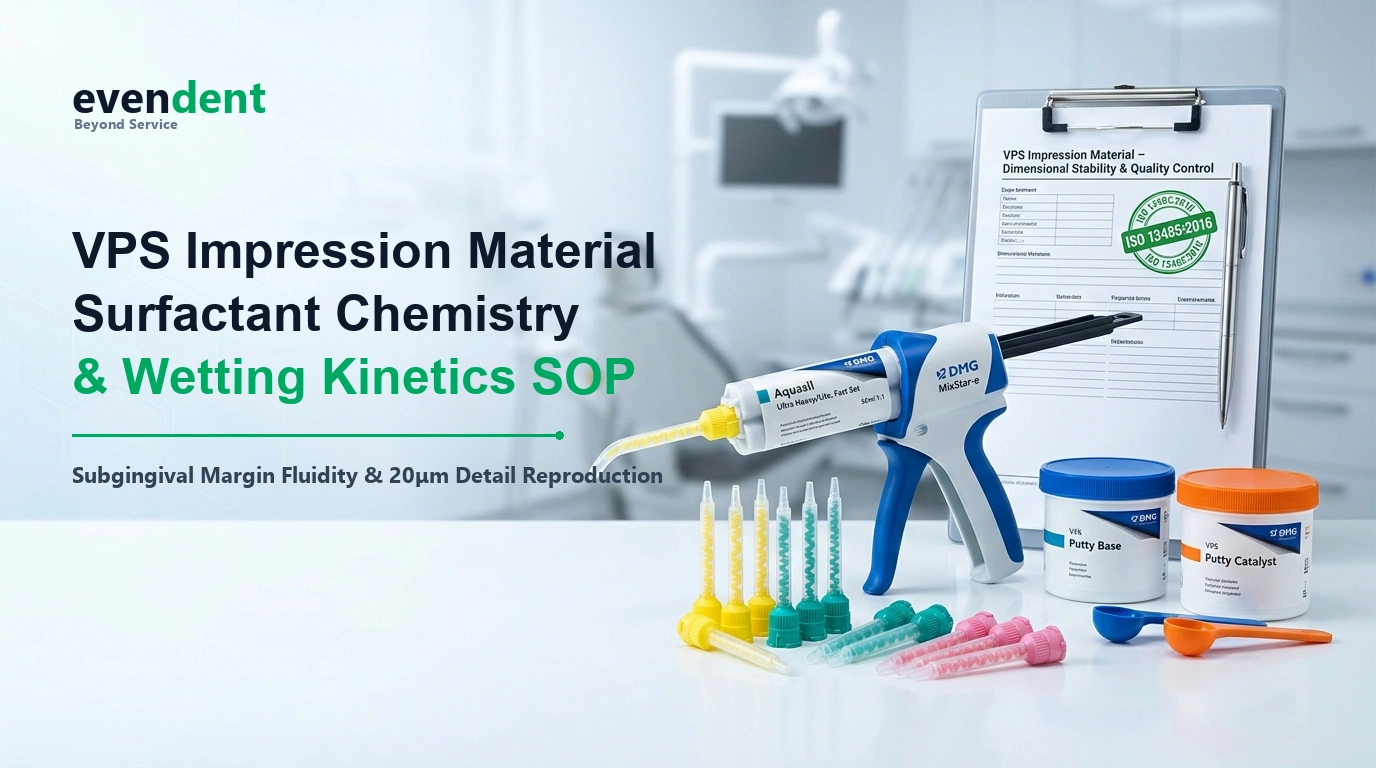

In subgingival crown and bridge preparations, veneer margins, and full-arch restorative dentistry, moisture control remains the single most common cause of impression failure. While standard addition-cure silicone (vinyl polysiloxane or VPS) offers unrivaled dimensional stability and elastic recovery, its pure polydimethylsiloxane backbone is inherently hydrophobic, exhibiting contact angles exceeding 90°.
To overcome this fundamental physical limitation, modern dental formulation science incorporates non-ionic polyether-modified surfactant molecules into the silicone matrix, producing hydrophilic VPS impression materials capable of displacing sulcular fluids and reproducing micro-details under 20 μm.
1. The Surface Tension Dilemma: Hydrophobic vs. Hydrophilic Kinetics
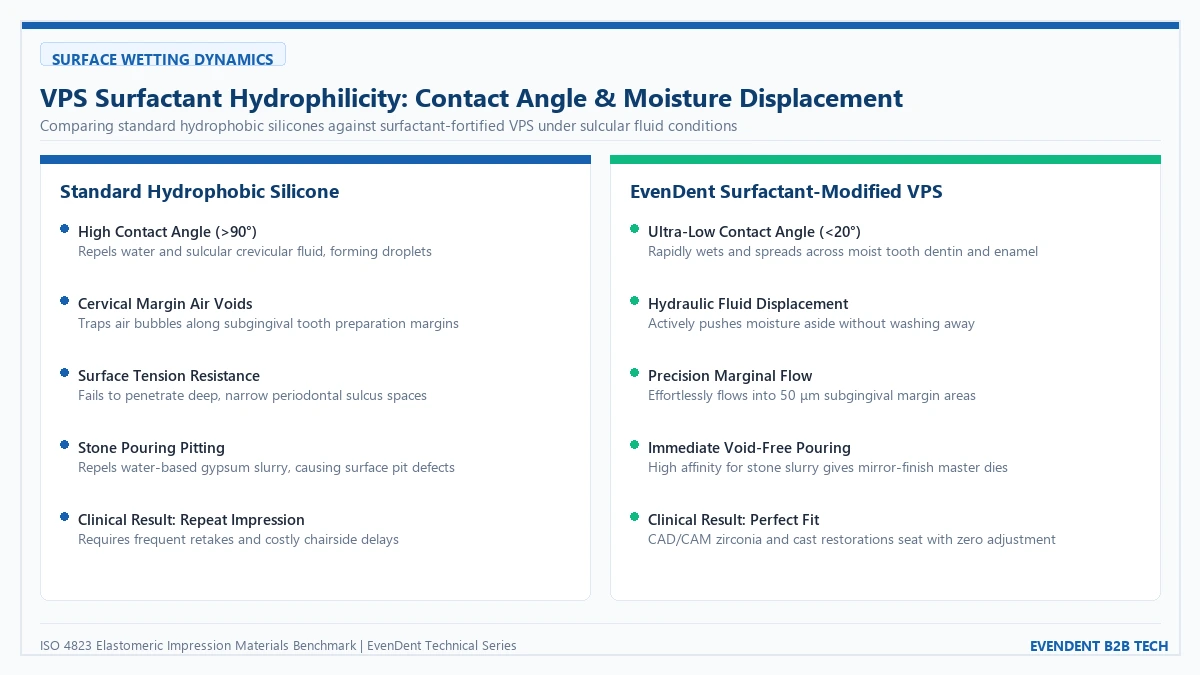
When an impression elastomer is injected around a prepared tooth, it encounters dentinal fluid, crevicular exudate, and residual saliva. On a hydrophobic elastomer surface, high interfacial tension causes moisture to bead up into droplets, entrapping air bubbles along critical preparation margins.
+------------------------------------------------------------------------+
|                VPS INTERFACIAL CONTACT ANGLE KINETICS                  |
+------------------------------------------------------------------------+
| Standard Polysiloxane (Hydrophobic Baseline):                          |
| Contact Angle: > 90°                                                   |
| ---> Droplet beading along gingival margin                             |
| ===> Trapped air voids & rounded crown margins                         |
|                                                                        |
| EvenDent Surfactant-Fortified VPS (Hydrophilic):                       |
| Initial Contact: ~45° ---> 10s Dynamic Drop: < 20°                     |
| ---> Rapid surface wetting & hydraulic fluid displacement              |
| ===> Sub-20 μm razor-sharp marginal detail reproduction                |
+------------------------------------------------------------------------+
Dynamic vs. Static Contact Angle
Clinicians must distinguish between static contact angle (measured on polymerized rubber) and dynamic wetting angle during the crucial working time:
* The 30-Second Window: Once injected from the automix tip, surfactant molecules within EvenDent Light Body VPS rapidly migrate to the material-tissue interface.
* Capillary Wetting: Within 10 seconds of intraoral contact, the wetting angle drops precipitously below 20°, enabling the wash material to flow smoothly across moist dentin without requiring aggressive air drying that causes post-operative sensitivity.
2. Chemical Architecture: Non-Ionic Polyether-Siloxane Surfactants
Generic silicones rely on topical surfactant coatings that wash away under intraoral fluid flow. In contrast, EvenDent hydrophilic VPS integrates intrinsically blended organo-modified siloxane surfactants:
- Dual-Affinity Molecular Structure: Possesses a siloxane hydrophobic anchor that bonds covalently into the polymerizing vinyl matrix, while hydrophilic polyoxyethylene side chains extend toward the moist tooth surface.
- Zero Leaching: Because surfactants are chemically integrated, they do not wash into oral tissues or interfere with subsequent gypsum hydration when pouring stone dies.
- Gypsum Affinity (Stone Pouring): The high surface energy persists on the set impression, enabling water-based gypsum slurries (Type IV Dental Stone) to wet the rubber instantly without requiring anti-bubble surfactant sprays.
3. Physical & Rheological Comparison Matrix
Tested under ISO 4823 (Dentistry – Elastomeric impression materials) laboratory parameters:
| Technical Parameter | EvenDent Hydrophilic VPS | Conventional Generic VPS | Polyether Impression Material | Condensation Silicone |
|---|---|---|---|---|
| Dynamic Contact Angle (10s) | < 20° (Ultra-Wetting) | 75° – 95° (Hydrophobic) | < 15° (Inherently hydrophilic) | > 90° (Repels moisture) |
| Marginal Detail (ISO 4823) | <= 20 μm Line Clean | 50 μm (Rounded edges) | <= 20 μm Clean | 50 – 75 μm Variable |
| Elastic Recovery from Undercuts | > 99.5% (ISO Standard) | 99.0% | 98.2% (Rigid removal) | 97.0% (Plastic warp) |
| Dimensional Stability (24h) | < 0.15% Linear Drift | < 0.20% | < 0.25% (Water sensitive) | > 0.80% (Alcohol loss) |
| Tear Strength (Interproximal) | > 2.8 N/mm High Tear | 1.8 – 2.2 N/mm | 1.5 – 2.0 N/mm (Brittle) | 1.2 – 1.6 N/mm |
| Immediate Gypsum Pouring | Bubble-Free (Zero Gas) | Pits from H2 gas | Requires dry storage | Severe shrinkage |
4. Clinical Injection Protocol for Subgingival Margins
To fully harness the surfactant wetting mechanics during restorative procedures:
- Sulcular Management: Utilize a two-cord retraction technique or soft tissue laser to expose the entire 360-degree finish line. Remove the top cord immediately prior to syringing.
- Continuous Tip Immersion: Dispense EvenDent Light Body VPS using a precision intraoral tip. Keep the tip continuously immersed within the advancing fluid stream to prevent entrapping ambient air.
- Hydraulic Heavy Body Seating: Immediately seat the tray containing VPS Putty / Heavy Body. The high-viscosity tray material creates positive hydraulic pressure that forces the low-viscosity hydrophilic wash deep into the micro-sulcus.
- Snap-Set Polymerization: Maintain passive stability for 3 minutes intraorally. The sudden snap-set transition prevents distortion caused by minor patient swallowing movements.
5. B2B Sourcing, Packaging & Cleanroom Compliance
For dental distributors and institutional procurement officers, impression material reliability is directly tied to chemical batch consistency and barrier packaging:
* Dual-Barrel Cartridge Integrity (50 mL 1:1 / 2:1): High-barrier polyolefin cartridges engineered to prevent cross-contamination between platinum catalyst and vinyl base prepolymers.
* Shelf-Life Stability: Packaged in moisture-proof vacuum pouches with desiccant to guarantee 24 months of stable working time, even in tropical high-humidity climates.
* Regulatory Documentation: Fully certified under ISO 13485:2016 and CE Class I Medical Device Regulation (EU MDR), accompanied by full-batch Certificate of Analysis (COA) confirming zero hydrogen gas outgassing.

 English
 Español
 Português
 Français
 Italiano
 Deutsch
 Русский
 日本語
 한국어
 العربية