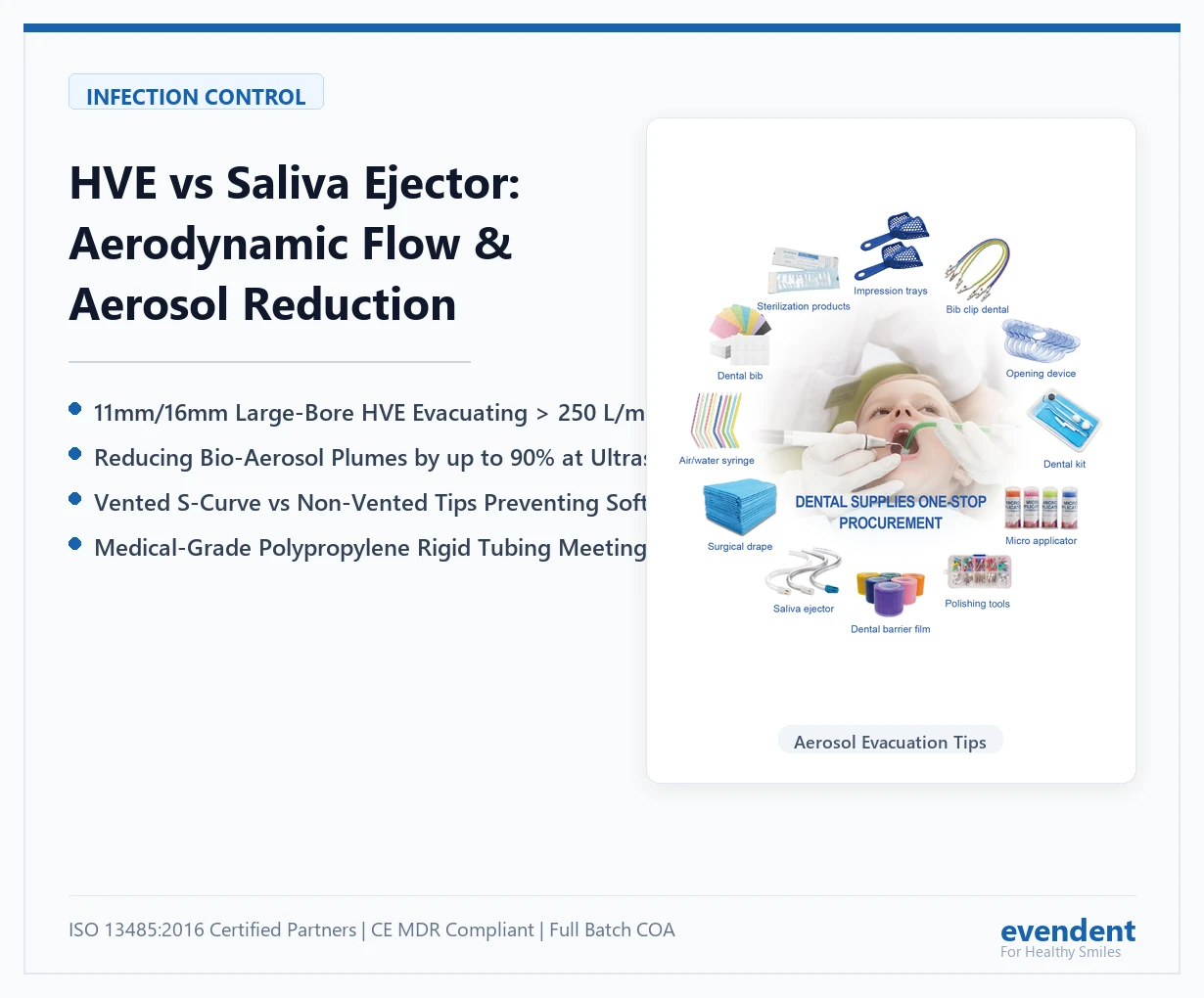

Dental operatory aerosol management has become a critical infection control parameter worldwide. Routine procedures—including ultrasonic scaling, high-speed handpiece crown preparation, and air polishing—generate massive plumes of airborne bio-aerosols laden with blood, saliva, oral bacteria, and viral particles that remain suspended in operatory air for hours.
Many practices mistakenly rely on standard Saliva Ejectors for aerosol control. However, aerodynamic physics dictates that only High-Volume Evacuator (HVE) Suction Tips generate the required volumetric airflow to capture splatter and aerosol plumes at the operative source.
1. Aerodynamic Physics: Volumetric Airflow vs. Negative Vacuum Pressure
The fundamental difference between HVE tips and standard saliva ejectors lies in the relationship between bore diameter, airflow velocity, and evacuation volume:
+------------------------------------------------------------------------+
|                 SUCTION EVACUATION AERODYNAMIC COMPARISON              |
+------------------------------------------------------------------------+
| Standard Saliva Ejector (Bore ~ 4.0 mm)                                |
| [ High Negative Pressure / Low Airflow: ~ 15 to 25 L/min ]             |
| ===> Removes pooled liquid in floor of mouth; ZERO aerosol capture     |
|                                                                        |
| High-Volume Evacuator (HVE Bore ~ 11.0 to 16.0 mm)                     |
| [ Moderate Pressure / Massive Volumetric Flow: > 250 to 300 L/min ]    |
| ===> Captures high-velocity aerosol cone at bur/scaler tip (> 90% plume)|
+------------------------------------------------------------------------+
The Cross-Sectional Area Multiplier
- The cross-sectional area of a conduit is proportional to the square of its radius (A = π r²).
- An 11.0 mm standard HVE tip provides an intake area of 95.0 mm², compared to just 12.6 mm² for a 4.0 mm saliva ejector—an area increase of over 750%.
- While a saliva ejector creates high static suction that easily pulls liquids resting on oral tissues, its intake air velocity drops off within 5 mm of the tip opening, rendering it ineffective against aerosol clouds flying away from high-speed burs at 400,000 RPM.
2. Bio-Aerosol Mitigation: Clinical Test Benchmarks
Peer-reviewed infection control studies (CDC and ADA guidelines) benchmark the efficacy of various evacuation devices:
| Clinical Suction Setup | Operatory Airflow Rate | Bio-Aerosol Plume Reduction | Primary Clinical Purpose |
|---|---|---|---|
| Standard Low-Volume Saliva Ejector | 15 – 25 L/min | < 10% – 15% (Ineffective) | Pooled saliva and water removal from floor of mouth |
| Standard Disposable HVE Tip (11mm) | 250 – 300 L/min | 90% – 95% Reduction | Ultrasonic scaling, cavity preps, surgical evacuation |
| Large-Bore Surgical Aspirator (16mm) | 320 – 380 L/min | 95% – 98% Reduction | Surgical extractions, bone grafting, high-bleed sites |
| Dual Evacuation (HVE + Saliva Ejector) | Combined System | > 98% Total Containment | Maximum safety standard for aerosol-generating procedures |
3. Ergonomic Tip Geometry: Vented S-Curve vs. Non-Vented Straight Tips
To balance high-volume air draw with patient tissue comfort, HVE tips are manufactured in specialized tip architectures:
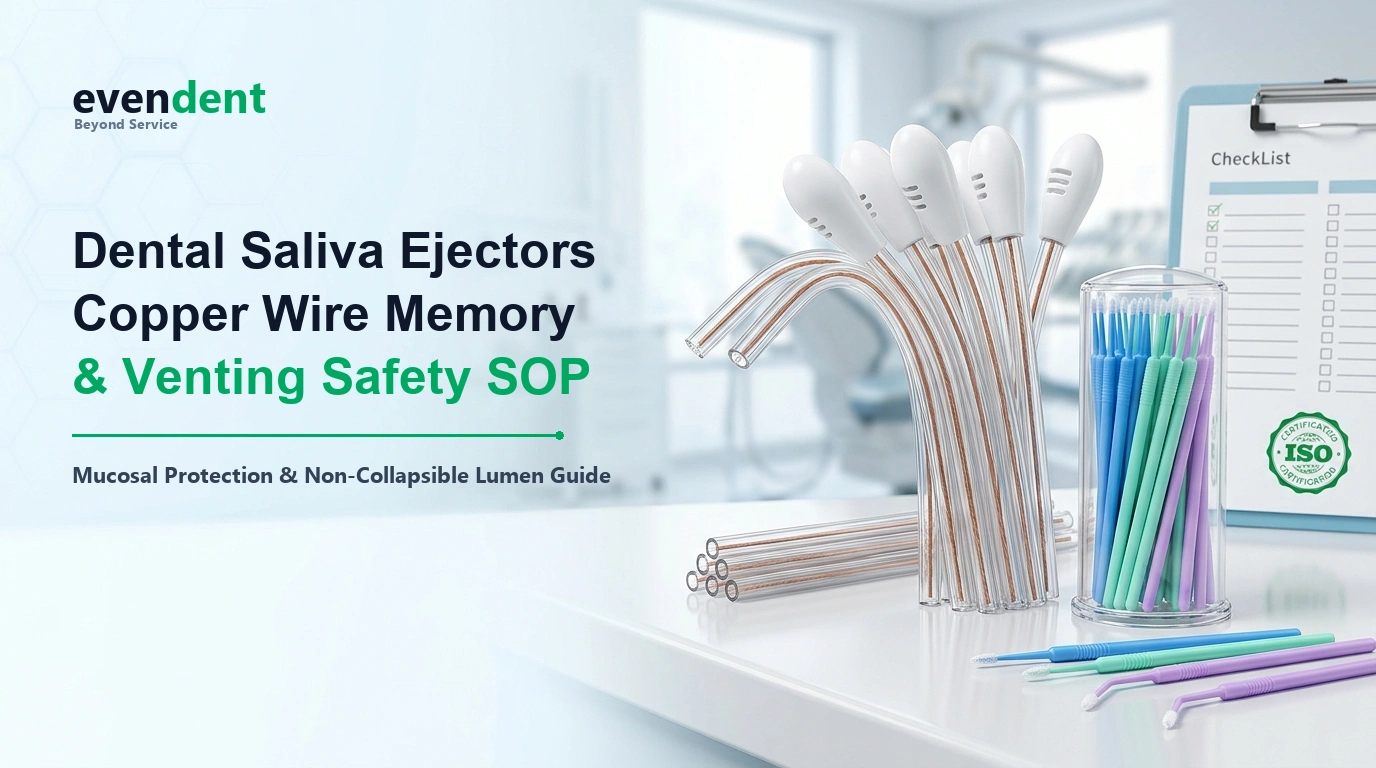
1. Vented S-Curve Tips
- Features continuous relief vents or side slits near the primary intake orifice.
- Anti-Invagination Safety: If the tip accidentally contacts the patient’s buccal mucosa or tongue, air continues to flow through the side vents, preventing traumatic soft tissue grabbing while maintaining continuous vacuum flow through the operatory line.
- S-Shape Curvature: Ergonomically balances along the dental assistant’s hand, providing a natural sightline into posterior quadrants.
2. Non-Vented Straight Tips
- Delivers 100% focused axial vacuum force directly through the main bore.
- Preferred during high-bleed oral surgery and implant osteotomies where immediate fluid clearing and bone chip removal take precedence over soft-tissue ventilation.
4. Material Science: Rigid Biocompatible Polypropylene vs. Soft Tubing
Disposable HVE tips must be rigid enough to function as a soft-tissue retractor while maintaining strict patient safety standards:
- High-Rigidity Polypropylene (PP):
- Engineered with thick flange walls that do not collapse under heavy vacuum pull or when retracting tough muscular cheek tissue.
- Features smooth, flame-polished or precision-molded border edges to eliminate burrs that could lacerate the oral vestibule.
- Single-Use Disposable Standard:
- Completely eliminates the labor-intensive cleaning, ultrasonic bath cycle, and autoclave reprocessing of reusable metal aspirator tubes.
- Guarantees zero risk of cross-contamination between patients in compliance with ISO 13485 and CDC infection control guidelines.
5. Wholesale Sourcing & Packaging Optimization
For medical supply distributors, dental hygiene institutions, and dental hospital supply departments:
- Size Specifications: Standard 11.0 mm outer diameter fitting all universal HVE valves; 145 mm total length; available in Vented and Non-Vented formats.
- Color-Coding / Assortment: Clean white, medical blue, or assorted bright pastel colors to complement modern operatory aesthetics.
- Packaging Formats: 100 pcs per hygienic dispenser bag; 10 bags per master export carton (1,000 pcs total). High-density nested packing reduces ocean freight cubic volume (CBM) by up to 25%.
- Regulatory Documentation: Fully compliant with CE Class I medical device regulations, FDA listing, and ISO 10993 biocompatibility testing (cytotoxicity, oral irritation, and systemic toxicity tests passed).
Related EvenDent Products & Guides:
– Products: dental saliva ejector – full range in the Oral Consumables category hub.
– Further Reading: saliva ejector wholesale guide.


 English
 Español
 Português
 Français
 Italiano
 Deutsch
 Русский
 日本語
 한국어
 العربية