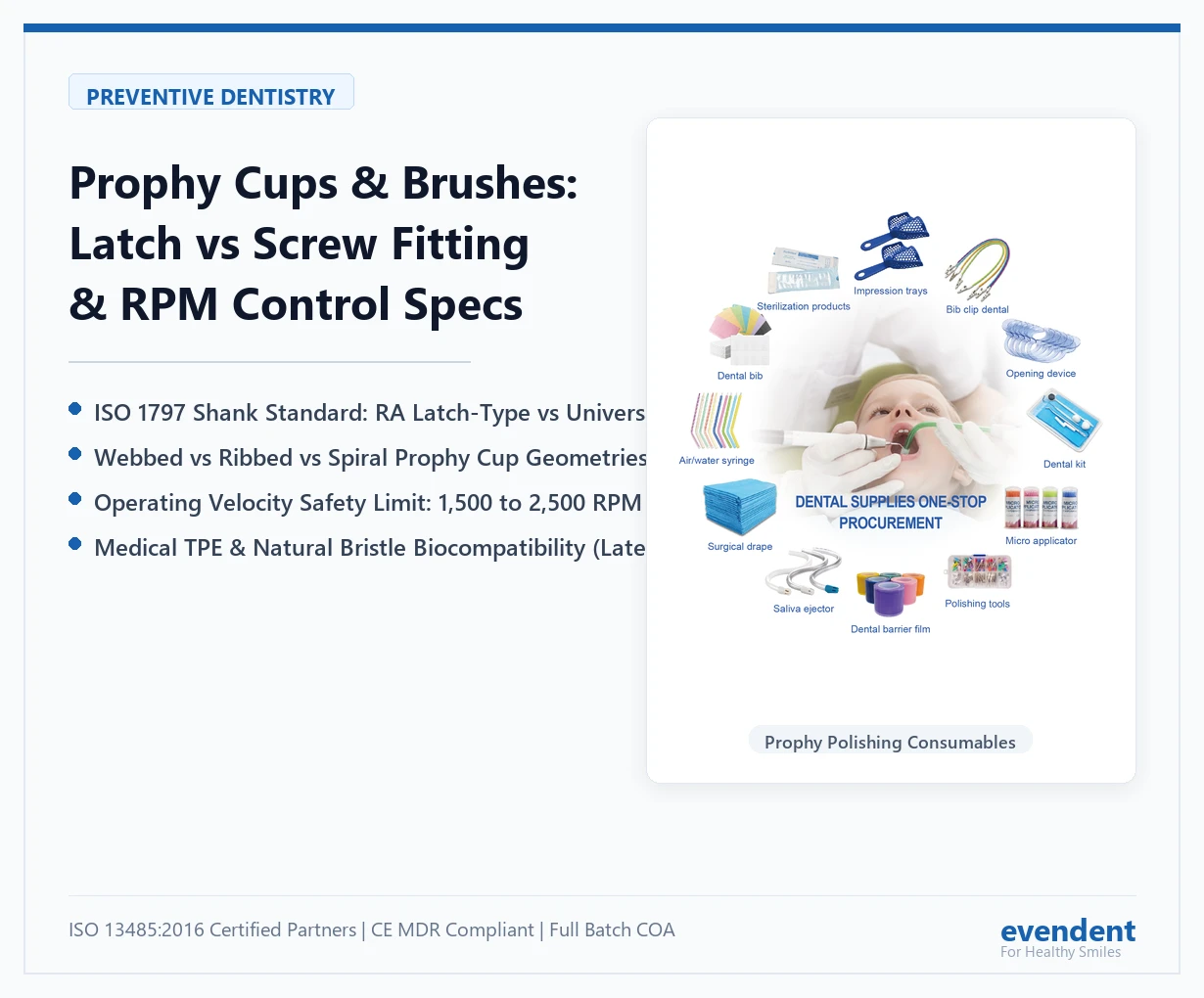

In preventive oral prophylaxis, mechanical biofilm removal and extrinsic stain polishing are performed using rotary disposable prophy cups and prophy brushes. While seemingly simple consumables, improper shank fitting, poor elastomer flexibility, or excessive rotational speeds can cause irreversible iatrogenic damage, including dental pulp overheating, enamel scratching, and severe gingival papilla abrasion.
Selecting the appropriate cup geometry, bristle firmness, and shank interface—coupled with rigorous rotational speed (RPM) management—is vital for dental clinics and hygiene institutions.
1. Shank Interface Standards: RA Latch-Type vs. Threaded Screw-Type
Dental prophy angles and contra-angle handpieces utilize standardized mechanical coupling systems governed by ISO 1797 (Dental rotary instruments – Shanks):
+------------------------------------------------------------------------+
|                      SHANK INTERFACE ARCHITECTURES                     |
+------------------------------------------------------------------------+
|  RA Latch-Type (Right-Angle ISO 204 Type 2)                           |
|  [ Notch Groove (2.35 mm Dia) ] ===> Engages mechanical latch push pin |
|                                                                        |
|  Threaded Screw-Type (Universal Prophy Mandrel)                        |
|  [ Precision Micro-Thread M2.0 ] ===> Direct screw mount into mandrel  |
|                                                                        |
|  Snap-On Type (Elastomeric Button)                                     |
|  [ Female Push Socket ] ===> Presses over ball-end hygiene mandrel     |
+------------------------------------------------------------------------+
1. RA Latch-Type (Right Angle / Contra Angle)
- Features a standard cylindrical shank (2.35 mm diameter) with a milled half-moon retention notch.
- Inserts directly into any standard slow-speed contra-angle handpiece or low-speed latch head.
- Provides robust mechanical locking, preventing accidental shank ejection during high-drag subgingival polishing.
2. Threaded Screw-Type
- Features an integrated micro-threaded metal or hard polymer screw that threads directly into a dedicated hygiene contra-angle mandrel.
- Eliminates run-out wobble, delivering exceptionally smooth rotational balance and allowing shorter overall head height for superior posterior molar access.
3. Snap-On Type
- Designed with an elastic rubber socket that snaps directly over a round metal button mandrel.
- Offers rapid one-handed replacement between coarse and fine polishing steps, though it exhibits slightly lower retention force under heavy lateral load.
2. Cup Design Geometries: Webbed vs. Ribbed vs. Spiral
The internal design of a disposable prophy cup dictates paste carrying capacity, splatter control, and tooth surface adaptation:
| Cup Internal Architecture | Mechanism of Action | Recommended Clinical Application | Splatter Tendency |
|---|---|---|---|
| Webbed (Segmented Inner Walls) | Radial internal divider ribs create micro-reservoirs that hold polishing paste against centrifugal force | General cleaning and moderate stain polishing on buccal/lingual surfaces | Very Low (Retains paste within cup) |
| Ribbed (Straight Fluted Ridges) | Flexible vertical ridges wipe smoothly over curved convex tooth surfaces while flexing under light pressure | Interproximal polishing and delicate cervical margins | Low to Moderate |
| Spiral / Turbine Grooves | Spiral vanes continuously guide extruded prophy paste back toward the center of the cup during clockwise rotation | High-efficiency stain removal, orthodontic bracket margins | Lowest (Active centrifugal recovery) |
| Pointed Tip / Sulcus Cups | Narrow, tapered elastomeric cone designed for subgingival gingival embrasure penetration | Furcation areas, crowded anterior teeth, periodontal maintenance | Minimal |
3. Material Science: Natural Rubber vs. Synthetic Medical TPE
The elastomeric composition of the cup directly affects patient comfort, tactile feedback, and regulatory compliance:
- 100% Latex-Free Synthetic TPE (Thermoplastic Elastomer):
- Essential for preventing Type I IgE-mediated allergic reactions in latex-sensitive patients and staff.
- Engineered to maintain optimal flexural modulus without softening in the presence of saliva, friction heat, or acidic polishing pastes.
- Hardness Durometer (Shore A Scale):
- Soft (Light Blue / Pink, 45–55 Shore A): Highly flexible, flares easily around the gingival margin with minimal pressure; maximum patient comfort.
- Medium/Firm (Dark Blue / White, 60–70 Shore A): Greater structural resistance; delivers aggressive abrasive scrubbing for heavy tobacco and coffee stains.
4. Clinical RPM Control and Friction Heat Safeguards
Thermal transfer into the dental pulp chamber during rotary polishing can exceed the critical threshold of +5.5°C, leading to pulpal inflammation or necrosis if rotational speed and pressure are uncontrolled:
+---------------------------------------------------------------------+
|                  CLINICAL POLISHING SAFETY PARAMETERS               |
+---------------------------------------------------------------------+
| Rotational Velocity:  1,500 to 2,500 RPM (Never exceed 3,000 RPM)  |
| Contact Pressure:     Light touch (approx. 20 to 30 grams force)   |
| Motion:               Continuous intermittent dabbing (1-2 sec/spot)|
| Lubricant:            Adequate paste load (Never polish dry tooth) |
+---------------------------------------------------------------------+
- Prophy Brushes for Occlusal Fissures: Prophy brushes (nylon bristle or natural horsehair) must be restricted to occlusal pits, fissures, and lingual grooves. Never use rotary brushes on smooth cervical enamel or exposed cementum, as rigid bristles can scratch enamel prisms and lacerate the epithelial attachment.
5. Wholesale Bulk Packaging & Quality Assurance
For dental distributors, hygiene schools, and DSO hospital supply chains:
- Bulk Quantity Formats: 100 pcs per box, 1,000 pcs per clinic dispenser carton, or individually blister-packed units for sterile surgical prophylaxis.
- Color-Coded Sizing: Universal color coding distinguishes Soft, Regular, and Firm cup types at a glance.
- Regulatory Compliance: Sourced through partners operating under ISO 13485:2016 quality management systems with CE Class I registration, FDA listing, and cytotoxicity testing (ISO 10993-5) verifying 100% biocompatibility and latex-free certification.
Related EvenDent Products & Guides:
– Products: prophy cup, prophy brush – full range in the Oral Consumables category hub.
– Further Reading: prophy angles & cups guide.

 English
 Español
 Português
 Français
 Italiano
 Deutsch
 Русский
 日本語
 한국어
 العربية