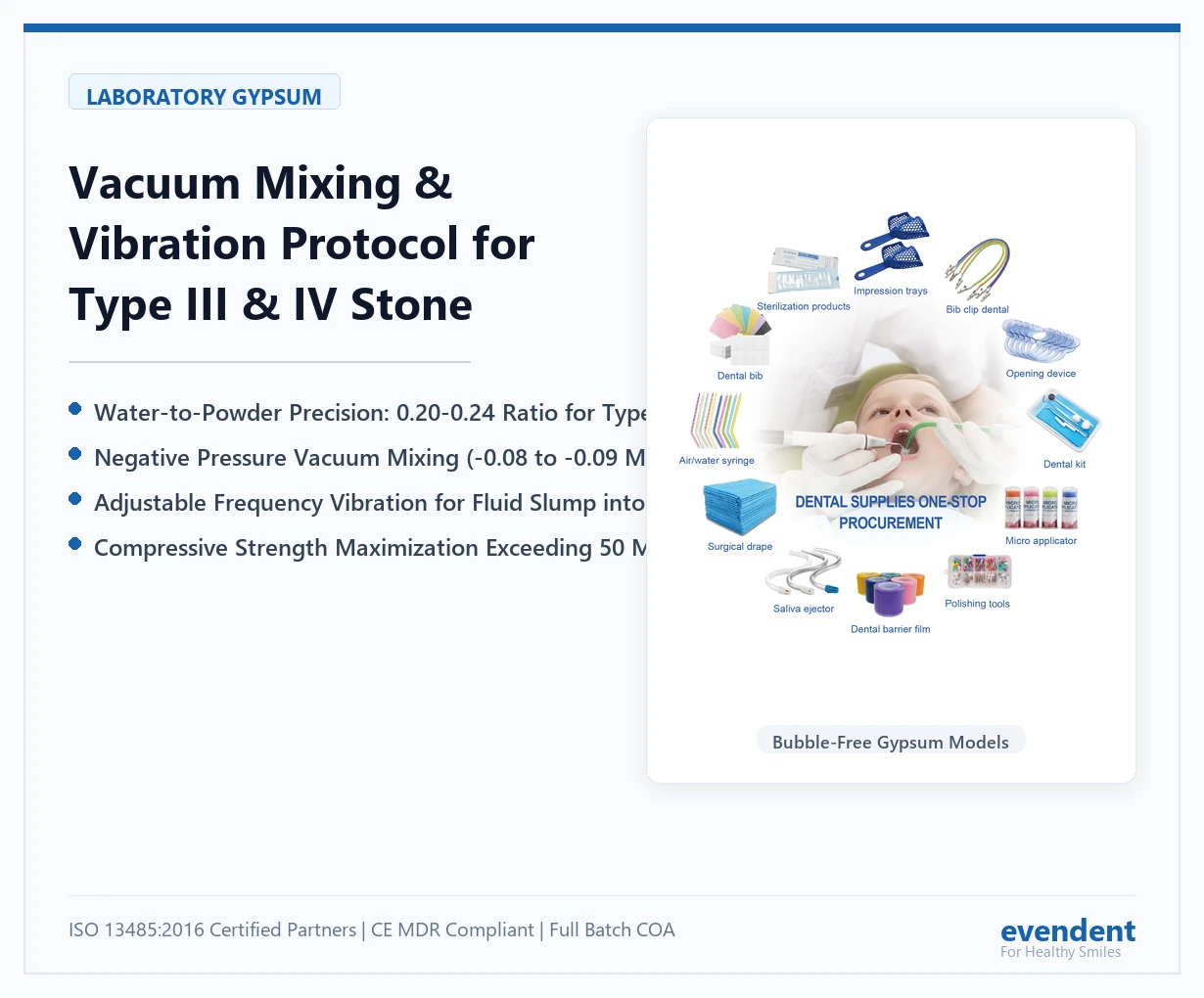

The accuracy of dental prosthetic restorations—from single CAD/CAM zirconia crowns to cast partial denture cobalt-chromium frameworks—relies on the dimensional fidelity of the master stone cast. While high-grade Type III dental stone (hydrocal) and Type IV die stone (densite) possess high theoretical compressive strengths, manual spatulation and improper pouring technique introduce microscopic air entrapment and variable water-to-powder ratios that ruin cast margins.
Implementing standardized Vacuum Power Mixing and High-Frequency Vibration Protocols ensures that stone casts achieve their maximum mechanical strength, uniform setting expansion, and pore-free surfaces.
1. Crystallographic Physics: Alpha-Hemihydrate vs. Water-to-Powder Precision
Gypsum products are manufactured by calcining calcium sulfate dihydrate (CaSO₄ · 2H₂O):
Particle Geometry and Excess Water Burden
- Type III Dental Stone: Composed of regularly shaped, moderately prismatic α-hemihydrate crystals. Requires a water-to-powder (W/P) ratio of 0.28 to 0.32 (28–32 mL water per 100 g powder).
- Type IV Die Stone: Subjected to high-pressure autoclaving in the presence of deflocculating additives, creating ultra-dense, cuboidal α-modified hemihydrate crystals. Requires only 0.20 to 0.24 W/P ratio.
- The Porosity Penalty: Stoichiometrically, only 18.6 mL of water is consumed to chemically convert 100 g of hemihydrate back into dihydrate. Any excess “free water” acts as a space occupier between crystals; as this water evaporates during drying, it leaves microscopic porosity. Adding just 2 mL of excess water above manufacturer specifications reduces 24-hour compressive strength by over 25%.
2. Standard Operating Procedure: Vacuum Mechanical Mixing
Hand mixing in an open rubber bowl entraps ambient air into the viscous slurry, resulting in internal voids that cause die margin chipping under dental lab burs.
+-----------------------------------------------------------------------+
|                VACUUM STONE MIXING WORKFLOW SEQUENCE                  |
+-----------------------------------------------------------------------+
| 1. Weigh Powder (Electronic Scale) & Measure Distilled Water (Pipette)|
|                                |                                      |
| 2. Water First into Bowl -> Add Powder -> Hand Spatulate (15 Seconds) |
|                                |                                      |
| 3. Engage Vacuum Mixer (-0.08 to -0.09 MPa Negative Pressure)         |
|                                |                                      |
| 4. Motorized Spatulation: 350-450 RPM for Exactly 45 Seconds          |
|                                |                                      |
| 5. Continuous Vacuum Hold for 10 Seconds -> Clean Release Valve       |
+-----------------------------------------------------------------------+
Critical Operational Control Points
- Distilled Water Consistency: Always use deionized or distilled water at room temperature (21°C to 23°C). Tap water containing variable mineral concentrations (calcium, sulfates, carbonates) unpredictably alters crystalline nucleation and setting expansion.
- Vacuum Gauge Calibration: Maintain a minimum vacuum level of -0.085 MPa (25 inches of Hg). Insufficient negative pressure fails to extract dissolved air micro-bubbles from the slurry.
- Mixing Speed and Duration: 45 seconds at 400 RPM provides total wetting of all powder particles without generating excessive frictional heat that could trigger premature crystal precipitation.
3. High-Frequency Mechanical Vibration: Flow Rheology Without Trapped Air
The purpose of vibration during pouring is not to force stone into the tray, but to decrease the dynamic viscosity of the slurry through thixotropic shear-thinning:
- Vibrator Intensity Setting:
- Set the dental vibrator to low-to-medium amplitude at high frequency (approx. 3,000–3,600 cycles per minute).
- Warning: Operating at excessive amplitude creates violent mechanical boiling, which actually forces air into the slurry rather than releasing it.
- Unidirectional Slump Flow:
- Invert the impression tray at a slight incline. Apply a small pea-sized increment of mixed stone to the highest anatomical point (typically the posterior molar region).
- Allow the vibration to induce smooth gravitational flow along the arch, displacing air ahead of the stone stream into the incisal and occlusal crevices. Never add stone from multiple opposite directions simultaneously, as this traps air pockets at the junction.
- Base Pouring & Exothermic Heat Dissipation:
- Build a sturdy 15 mm base. Allow the cast to set undisturbed for a minimum of 45 to 60 minutes before separation. Premature removal before the exothermic reaction concludes causes fracture of delicate tooth crowns.
4. Technical Benchmark Matrix: Hand Mixing vs. Vacuum Mechanical Mixing
| Diagnostic Property | Hand Spatulation & Manual Pour | Vacuum Power Mixing & Vibration | Clinical & Laboratory Impact |
|---|---|---|---|
| Linear Setting Expansion | 0.12% – 0.18% (Unstable) | 0.06% – 0.09% (Precise) | Controls crown fit; prevents tight contact points |
| 24-Hour Compressive Strength | 35 – 42 MPa | 55 – 65 MPa | Resists lab saw blade pressure and carving chipping |
| Surface Void Count (>0.2mm) | 12 – 28 voids per full arch | 0 – 1 void per full arch | Clean finish lines without hand-carving corrections |
| Reproduction of Detail (ISO 6873) | 50 μm line reproduction | 20 μm line reproduction | Ideal for optical scanning and digital die modeling |
| Slurry Consistency | Gritty, inhomogeneous | Creamy, glossy, homogenous | Effortless adaptation to elastomeric impression margins |
5. B2B Packaging & Bulk Storage Integrity
Dental gypsum is hygroscopic; exposure to relative humidity above 60% causes surface hydration of hemihydrate particles, leading to prolonged setting times and reduced final hardness:
- Commercial Packaging: EvenDent supplies premium Type III and Type IV dental stones in 1kg hermetic foil bags, 5kg moisture-barrier pouches, and 25kg fiber drums with integrated poly-liners.
- Quality Certification: Manufactured in accordance with ISO 6873:2013 (Dental gypsum products), accompanied by comprehensive batch-specific COA documenting W/P ratio, setting expansion percentage, and 2-hour/24-hour compressive test curves.
Related EvenDent Products & Guides:
– Products: dental stone type iv, dental stone type Ⅱ – full range in the Model Materials category hub.
– Further Reading: Type III vs. Type IV dental stone guide and Type IV dental stone guide.


 English
 Español
 Português
 Français
 Italiano
 Deutsch
 Русский
 日本語
 한국어
 العربية