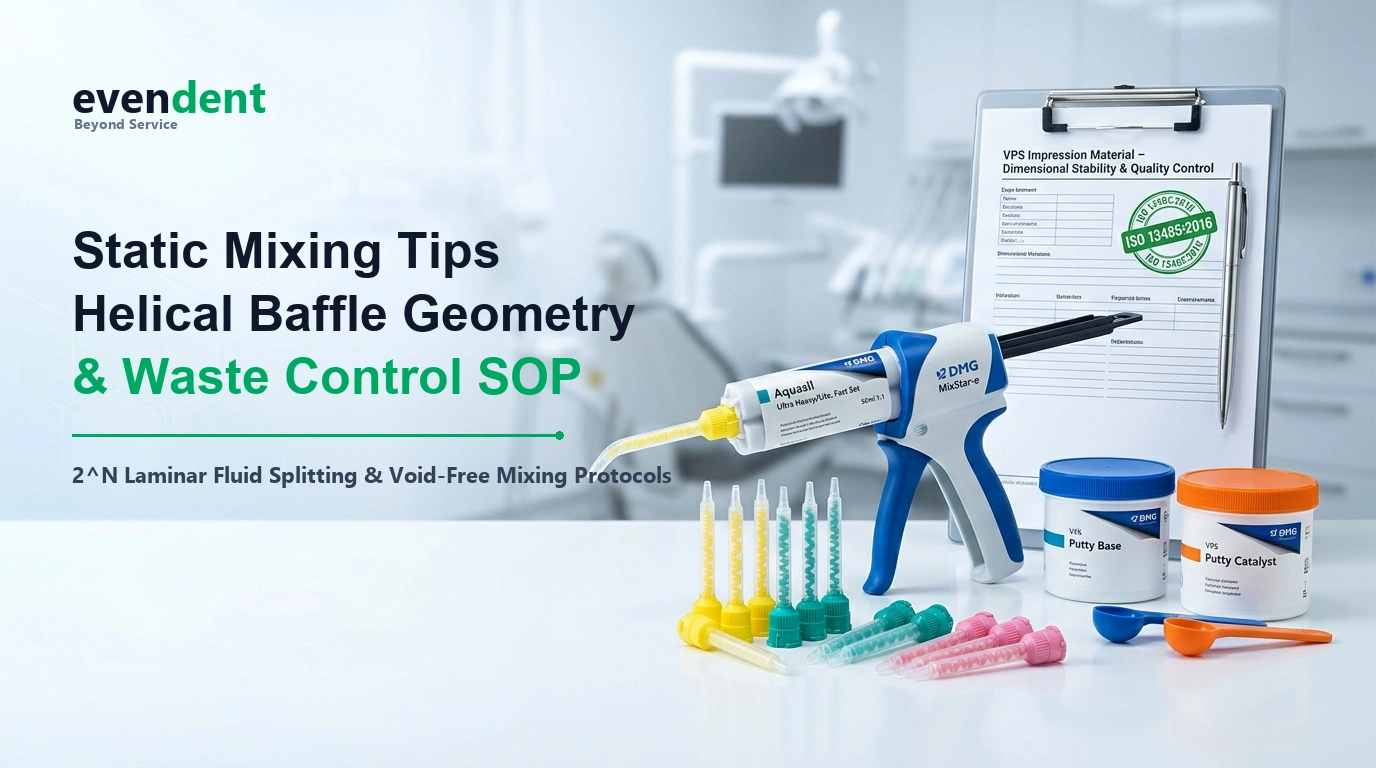

In contemporary restorative and prosthodontic dentistry, the delivery of automixed addition silicones (VPS) and polyethers has completely supplanted hand spatulation. By eliminating human error in proportioning and mechanical mixing, automix systems ensure optimal polymerization kinetics, void-free consistency, and predictable elastic recovery.
At the core of every automix cartridge lies the static mixing tip. Far from being an inert plastic nozzle, a modern mixing tip is an engineered fluid-propulsion reactor. Its internal helical baffle elements continuously divide, rotate, and recombine dual-component viscous polymers under laminar flow conditions.
1. The Physics of Laminar Fluid Splitting: The 2^N Principle
When base paste (vinyl polydimethylsiloxane) and catalyst paste (platinum complex) enter the mixer under pressure from a dental dispensing gun, they encounter a sequential series of stationary alternating left- and right-handed helical baffles:
+------------------------------------------------------------------------+
|                 LAMINAR FLOW DIVISION IN STATIC MIXERS                 |
+------------------------------------------------------------------------+
| Inlet: 2 Distinct Unmixed Fluid Streams (Base + Catalyst)              |
|                                                                        |
| Element 1: 180° Twist -> Splits streams into 4 distinct layers (2^2)   |
| Element 2: Opposite 180° Twist -> Splits into 8 layers (2^3)           |
| Element 3: Rotates & Re-divides into 16 layers (2^4)                   |
| ...                                                                    |
| Element 10 to 12: Continuous Geometric Division                        |
| ===> Over 1,024 to 4,096 interleaved micro-lamellae                     |
| ===> 100% Stoichiometric Molecular Homogeneity without Air Voids       |
+------------------------------------------------------------------------+
Eliminating the “Gummy Margin” Failure
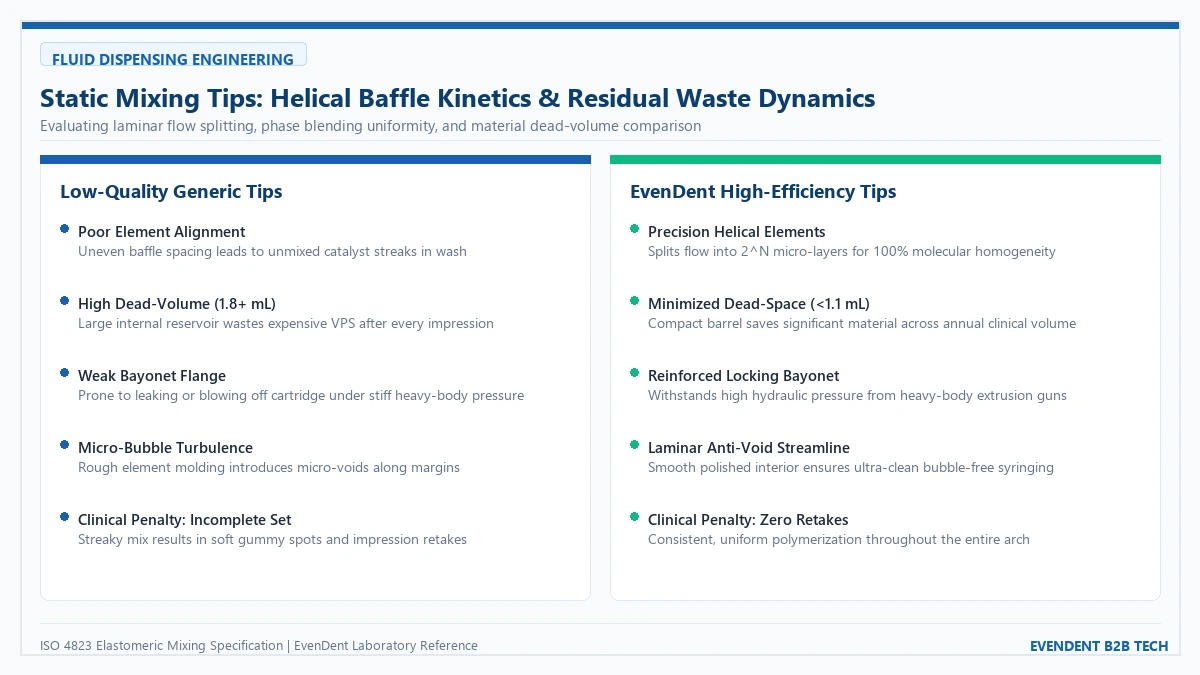
If a mixing tip possesses poorly aligned baffles, unblended streaks of pure catalyst or pure base emerge from the nozzle. When extruded along crown margins, these streaks cause localized polymerization inhibition—resulting in “gummy margins” that distort upon tray removal and necessitate costly impression retakes.
2. Waste Minimization: Controlling Residual Dead-Space Volume
For dental practices and multi-clinic DSOs, material waste represents a substantial operational overhead:
* The Residual Waste Trap: Conventional wide-barrel mixing tips retain between 1.6 mL and 2.2 mL of cured silicone within their internal lumen after each use. Across 10 cartridges (500 mL total), up to 15% to 20% of the entire impression material is discarded unused inside disposable tips.
* EvenDent Compact-Core Architecture: By optimizing the internal baffle diameter without restricting hydraulic throughput, EvenDent high-efficiency mixing tips reduce residual dead-space volume down to < 1.1 mL, conserving up to 30% of expensive wash materials per clinical procedure.
3. Engineering Benchmark: EvenDent vs. Generic Mixing Tips
Tested in accordance with ISO 4823 (Elastomeric impression materials) laboratory specifications:
| Technical Parameter | EvenDent High-Efficiency Tip | Standard Generic Mixing Tip | Hand-Mixed Pad Spatulation |
|---|---|---|---|
| Baffle Element Count | 12 Helical Elements (Optimized) | 10 – 12 Inconsistent Elements | Manual hand circles |
| Residual Dead-Space Volume | < 1.1 mL (High Material Savings) | 1.8 – 2.2 mL (Excessive Waste) | Variable pad residue |
| Hydraulic Burst Resistance | > 12 bar (Reinforced Bayonet) | 6 – 8 bar (Prone to leaking) | N/A |
| Air Void Inclusion Rate | < 0.05% (Microscope Tested) | 1.2% – 3.5% (Trapped Air) | 5% – 12% (Severe Bubbles) |
| Cartridge Interface Notch | Precision Dual-Notch Bayonet | Loose / Soft Flange | Manual syringe loading |
| Compatibility | 1:1 & 2:1 Universal 50 mL | Often binds or leaks | N/A |
4. Clinical Dispensing Best Practices
To achieve flawless clinical impressions with zero air entrapment:
1. Bleed the Cartridge First: Before mounting a new mixing tip onto a 50 mL cartridge, always extrude a pea-sized amount of material directly onto a gauze pad until base and catalyst flow equally from both barrels.
2. Mount and Lock Securely: Align the dual keyway notches of the tip with the cartridge neck and rotate the collar 90 degrees until a distinct tactile click confirms complete engagement.
3. Continuous Submerged Syringing: When injecting Light Body VPS around prepared margins, keep the nozzle tip continuously submerged within the flowing elastomer to prevent dragging air into the sulcus.
4. Leave Used Tip Mounted: After taking the impression, leave the used tip in place on the cartridge. The polymerized silicone inside acts as an airtight, contamination-proof seal until the next patient appointment.



 English
 Español
 Português
 Français
 Italiano
 Deutsch
 Русский
 日本語
 한국어
 العربية