

Disposable dental bibs (patient patient bibs / drape sheets) are consumed by the tens of millions annually across clinical dentistry. While often treated as simple commodity paper, dental bib performance is governed by precise mechanical engineering: balancing rapid liquid absorption by cellulose paper with an absolute leak-proof moisture barrier provided by laminated polyethylene (PE) cast film.
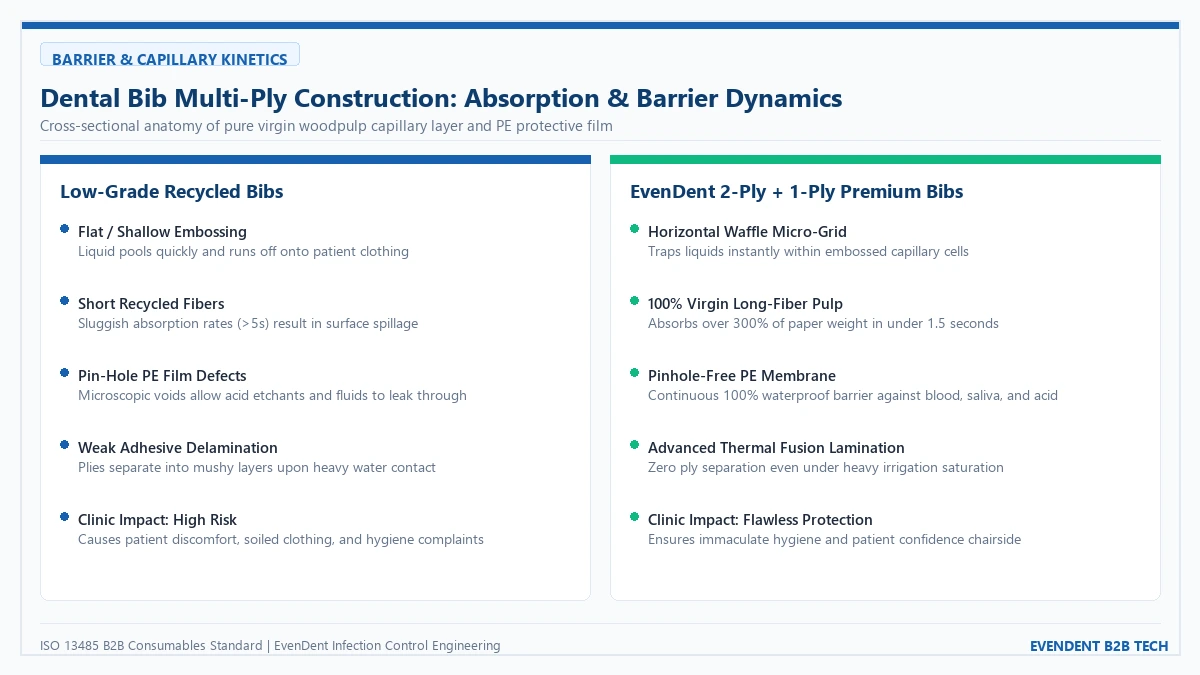
The critical manufacturing differentiator between premium and budget bibs is the Embossing Geometry, which controls fluid dispersion speed and prevents puddling during aerosol-heavy ultrasonic procedures.
1. Capillary Fluid Transport: Cellulose Fibers and Embossing Kinetics
When cooling water from high-speed handpieces or blood splatter strikes a patient bib, the fluid must be absorbed immediately to prevent liquid pooling and clothing contamination:
+------------------------------------------------------------------------+
|                 EMBOSSING LIQUID DISPERSION PROFILE                    |
+------------------------------------------------------------------------+
| Flat Smooth Paper (Unembossed):                                        |
| [ Fluid Pool ] ===> Slow vertical saturation; liquid runs off margins  |
|                                                                        |
| Horizontal Waffle Embossing: Directional Capillary Channels            |
| [ Fluid Strike ] ===> Channels guide fluid horizontally across bib     |
|                       Maximizes paper absorption area; ZERO runoff     |
+------------------------------------------------------------------------+
The Role of Micro-Pockets in Embossing
- Steel calendering rollers emboss mechanical relief patterns into the multi-ply cellulose web at temperatures between 130°C and 160°C.
- Micro-Reservoir Formation: The raised embossing nodes create thousands of microscopic air chambers between the paper plies. When droplets contact the surface, these micro-chambers generate negative capillary draw, pulling fluid horizontally across the web.
2. Technical Comparison: Horizontal Waffle vs. Cross-Grid vs. Pebble Embossing
| Embossing Architecture | Calendering Roller Geometry | Liquid Dispersion Velocity | Tensile Tear Resistance (Wet) | Tactile Softness Index |
|---|---|---|---|---|
| Horizontal Waffle (EvenDent) | Linear horizontal ridges with offset baffles | < 1.8 seconds (Instant spread) | High (> 14 N/50mm) | Superior (Comfortable drape) |
| Cross-Grid (Diamond / Square) | Diagonal intersecting criss-cross grid | 2.5 – 3.2 seconds | Moderate (Punctures at intersections) | Moderate |
| Pebble / Dimple Embossing | Isolated circular depression dimples | 4.0 – 5.5 seconds (Sluggish) | Low (Weakened bonding between nodes) | Fair (Slightly stiff) |
| Unembossed Smooth Sheets | Flat compression rollers | > 8.0 seconds (High runoff risk) | Very Low when wet | Poor (Paper feels like kraft) |
3. Lamination Integrity: 2-Ply Paper + 1-Ply PE Thermal Bonding
A disposable dental bib consists of three functionally distinct bonded layers:
- Top Layer (18 gsm 100% Virgin Wood Pulp):
- Formulated with long, unbleached virgin cellulose fibers that rapidly absorb surface fluids within two seconds of contact.
- Middle Layer (18 gsm Pure Cellulose Tissue):
- Functions as an internal absorption buffer, spreading moisture horizontally across the entire surface area of the bib.
- Bottom Layer (10–12 μm Polyethylene Barrier Film):
- Molded via extrusion casting; provides a 100% impermeable hydrophobic shield with zero water strike-through, protecting patient clothing against stains, chemicals, and bio-pathogens.
- Thermal Fusion (No Chemical Glue):
- High-end manufacturing fuses the PE film directly to the paper plies using calibrated heat and pressure, eliminating chemical adhesives that can emit odors or cause skin irritation.
4. Quality Control & Performance Testing Standards
Institutional hospital tenders evaluate dental bibs using standardized laboratory metrics:
- Water Strike-Through Resistance (AATCC 127): Tested under a 50 cm hydrostatic water head for 10 minutes. Zero droplet penetration must occur through the laminated PE film.
- Absorbency Rate (ISO 12625-8): Time required for a 0.1 mL droplet of distilled water to be completely absorbed into the cellulose matrix (standard: < 3.0 seconds; EvenDent: 1.5 – 1.8 seconds).
- Wet Tensile Strength: The bib must resist tearing when adjusted by dental bib clips or chain clamps, even when soaked with saliva or coolant spray.
5. Wholesale Sourcing & Pallet Logistics
For global medical distributors, hygiene supply wholesalers, and clinic buying groups:
- Standard Dimensional Sizes: Universal 33 cm x 45 cm (13″ x 18″) with precision die-cut neck contouring.
- Color Range: Medical Blue, Soft Pink, Lavender Purple, Mint Green, Clean White, and Modern Charcoal Grey to match diverse clinical branding schemes.
- High-Density Carton Packaging: 125 pcs/dispenser pack, 4 packs/carton (500 pcs/carton). Reinforced 5-ply export cartons allow 60 cartons per standard export pallet without crushing lower tiers.
- Regulatory Compliance: Produced in ISO 13485:2016 and ISO 9001 certified facilities with CE Class I registration and material biocompatibility dossiers verifying hypoallergenic, latex-free construction.
Related EvenDent Products & Guides:
– Products: dental bib – full range in the Oral Consumables category hub.
– Further Reading: dental bib wholesale guide.



 English
 Español
 Português
 Français
 Italiano
 Deutsch
 Русский
 日本語
 한국어
 العربية