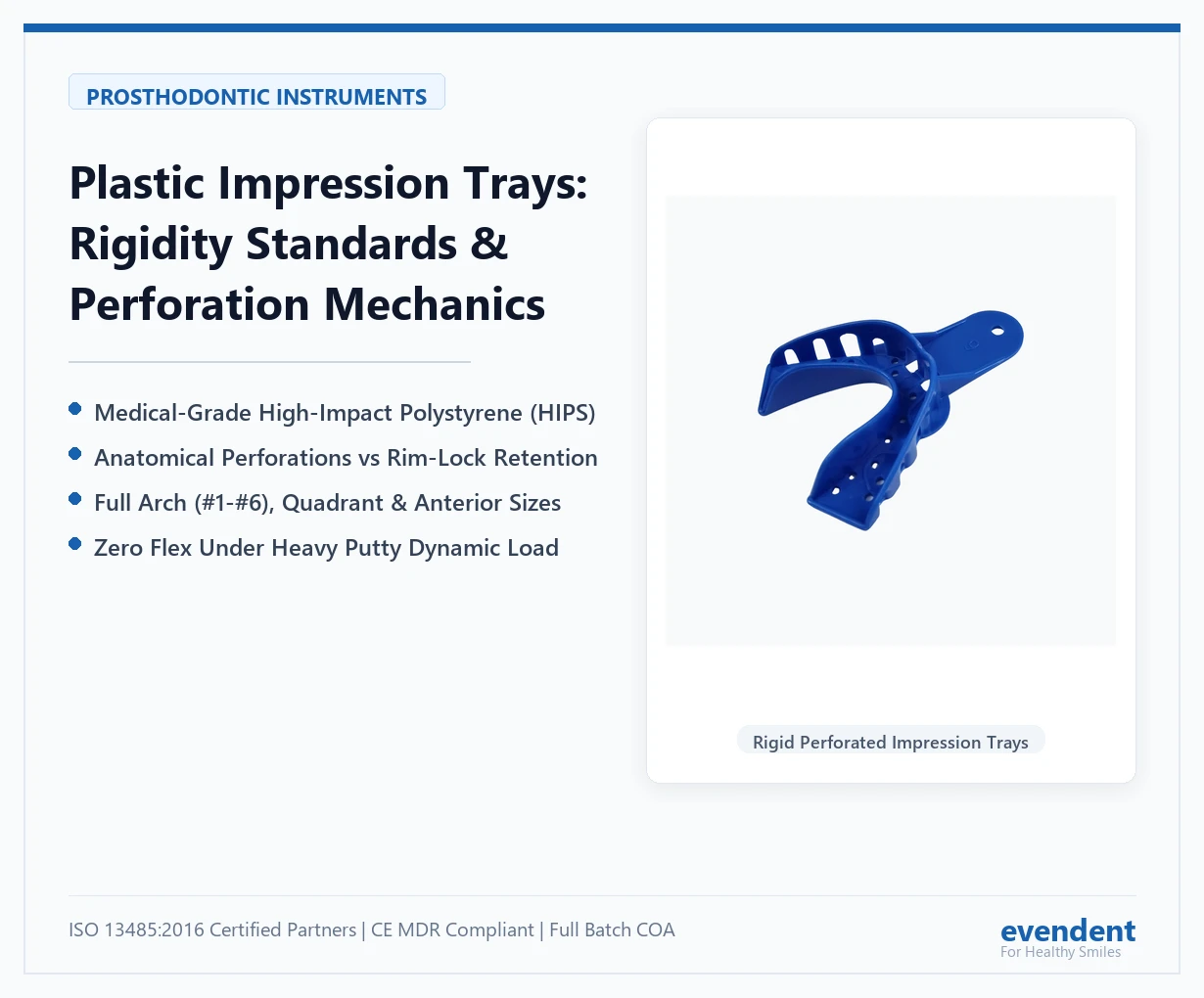

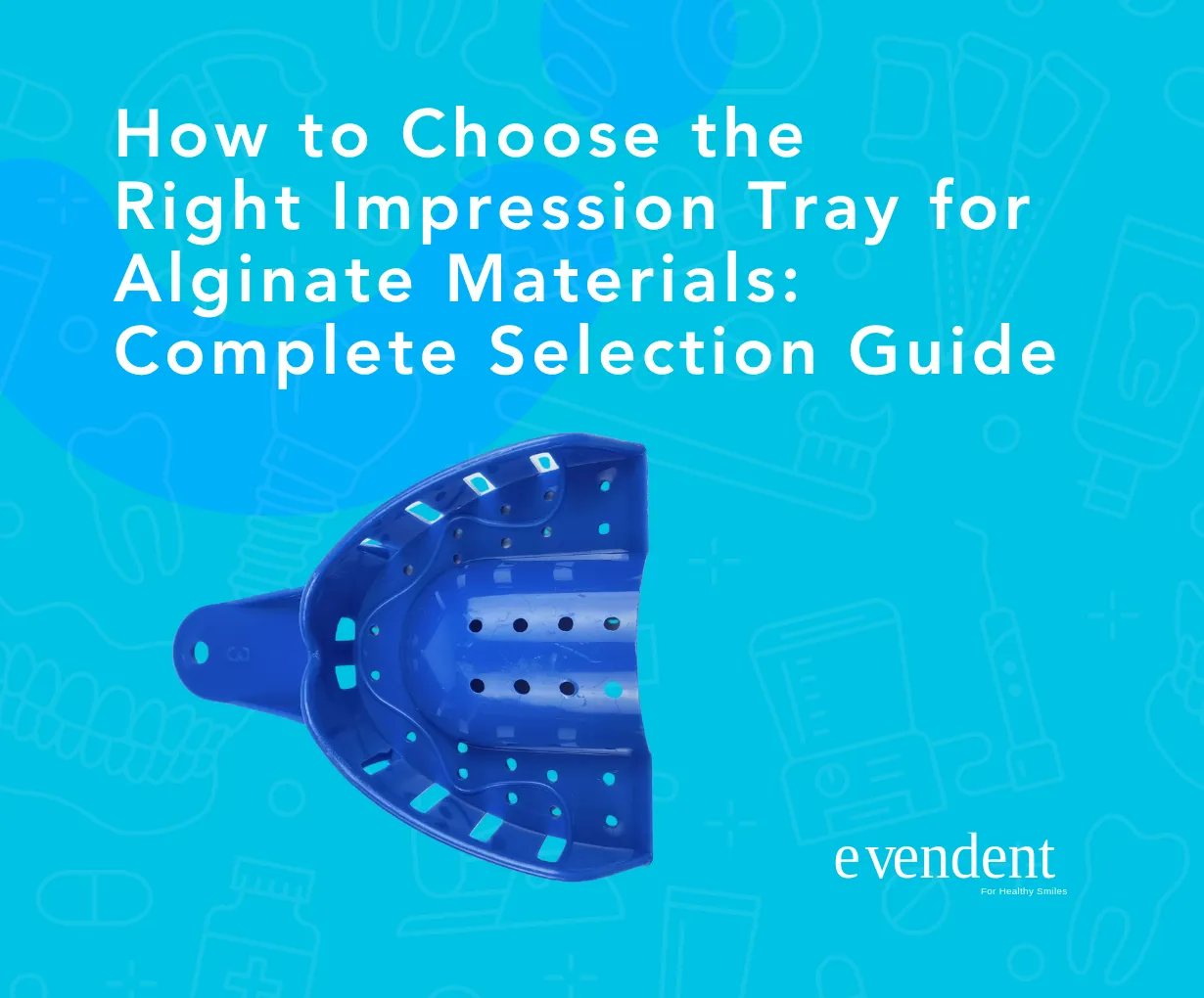
Accurate diagnostic study models, crown and bridge prosthetics, orthodontic appliances, and implant surgical guides all depend on the fidelity of the primary impression. While clinical discussions frequently focus on the chemistry of impression materials—such as high-precision dental alginate or addition silicone (VPS)—the structural rigidity and dimensional stability of the dental impression tray are equally decisive in preventing microscopic inaccuracies.
If an impression tray flexes under hydrostatic seating pressure or springs back upon removal from the oral cavity, the resulting stone cast will be permanently distorted. This results in ill-fitting prosthetics, repeated appointments, and wasted chairside time.
This comprehensive technical guide provides dental procurement managers, laboratory technicians, and clinicians with an engineering evaluation of disposable plastic impression trays: analyzing polymer composition, perforation mechanics, anatomical sizing architectures, and bulk wholesale logistics.
1. Material Mechanics: Why Tray Rigidity Dictates Impression Accuracy
When an impression tray loaded with viscous impression material is seated over the dental arch, hydrostatic resistance creates significant hydraulic forces outward against the buccal walls and upward against the palatal vault.
       [ Hydrostatic Pressure Vectors during Seating ]
                   ▲  ▲  ▲  (Palatal Force)
             ┌─────────────────┐
  Buccal ◄───┤  Impression Material  ├───► Buccal
   Force     └─────────────────┘     Force
             ▼                 ▼
        Flexible Tray Wall = Micro-Distortion
        Rigid Polystyrene Wall = Accurate Dimensional Cast
1.1 Structural Deflection Under Heavy-Body Load
- Polypropylene (PP) Disadvantages: Many low-cost generic trays use commercial-grade polypropylene. PP exhibits low modulus of elasticity (flexural modulus ~ 1.2–1.5 GPa). Under the seating resistance of heavy-body VPS or thick alginate, PP tray flanges bow outward. Upon retrieval from the mouth, the plastic relaxes, compressing the impression buccolingually and resulting in a narrower model.
- Medical-Grade High-Impact Polystyrene (HIPS) Advantages: EvenDent partner manufacturing lines utilize virgin, medical-grade High-Impact Polystyrene (flexural modulus > 2.4 GPa). HIPS provides rigid structural integrity without flexing under heavy seating pressures, guaranteeing 1:1 true-to-life dimensional transfer.
1.2 Thermal & Mechanical Stability
HIPS impression trays maintain dimensional stability within oral temperatures (35°C–37°C) and remain fully unreactive when exposed to liquid tray adhesives, disinfectant immersion baths (glutaraldehyde, sodium hypochlorite), and cold-sterilization solutions.
2. Retention Mechanics: Perforated Matrix vs. Rim-Lock Anatomy
For an impression material to reproduce oral contours accurately, it must remain rigidly anchored to the tray walls during removal. Any delamination or micro-separation between the set material and the tray creates catastrophic distortion in the final model.
| Retention Mechanism | Engineering Architecture | Primary Clinical Applications | Compatibility with Adhesives |
|---|---|---|---|
| Full Perforated Grid | Laser-cut or precision-molded mechanical apertures (2.2mm–2.8mm diameter) across entire base and flanges | Irreversible hydrocolloids (Dental Alginate), preliminary diagnostic models, study casts | Mechanical lock sufficient; optional tray adhesive enhances margin retention |
| Rim-Lock Peripheral Lip | Solid non-perforated tray walls with an undercut peripheral perimeter lip | High-viscosity Addition Silicones (VPS), Polyethers, crown & bridge masters | Mandatory application of chemical tray adhesive 5 minutes prior to loading |
| Hybrid Perforated Rim-Lock | Oval perforations along lingual/palatal vault + solid perimeter rim-lock flange | Implant open/closed tray impressions, dual-phase putty/wash combinations | Optimal versatility; maximum retention under severe undercut anatomical conditions |
2.1 The Fluid Dynamics of Perforated Apertures
The precision apertures in EvenDent perforated trays serve dual functions:
1. Mechanical Interlock: As the viscous alginate or silicone is pressed against the arch, small columns of material extrude through the perforations, forming mushroom-like caps on the exterior wall upon setting. This physical rivet secures the impression against vertical and lateral dislodgement forces during mouth retrieval.
2. Hydrostatic Pressure Release: Perforations vent excess material, preventing excessive pressure buildup that can cause soft tissue blanching or unwanted displacement of mobile teeth.
3. Anatomical Sizing System & Quadrant Geometries
An ill-fitting tray causes direct patient discomfort, impinges on bony tori or muscular attachments, and produces non-uniform material thickness across the arch (the leading cause of silicone polymerization shrinkage errors).
EvenDent supplies an internationally standardized 10-piece color-coded anatomical sizing series:
| Size Code | Anatomical Designation | Arch / Quadrant | Color Indicator | Arch Width (mm) | Arch Length (mm) |
|---|---|---|---|---|---|
| #1 | Large Upper (Maxillary) | Full Arch | Blue / Yellow | 70 mm | 58 mm |
| #2 | Large Lower (Mandibular) | Full Arch | Blue / Yellow | 72 mm | 56 mm |
| #3 | Medium Upper (Maxillary) | Full Arch | Red / White | 66 mm | 54 mm |
| #4 | Medium Lower (Mandibular) | Full Arch | Red / White | 68 mm | 52 mm |
| #5 | Small Upper (Maxillary) | Full Arch | Green / Blue | 62 mm | 50 mm |
| #6 | Small Lower (Mandibular) | Full Arch | Green / Blue | 64 mm | 48 mm |
| #7 | Quadrant Upper Right / Lower Left | Half Arch | Orange / Neutral | Universal | 50 mm |
| #8 | Quadrant Upper Left / Lower Right | Half Arch | Orange / Neutral | Universal | 50 mm |
| #9 | Anterior Upper | Anterior 6 Teeth | Translucent / Neutral | 60 mm | 35 mm |
| #10 | Anterior Lower | Anterior 6 Teeth | Translucent / Neutral | 55 mm | 30 mm |
3.1 Ergonomic Handle Engineering
- Rigid Lever Arm: Reinforced ribbed handles prevent torsional twisting during retrieval from deep retentive undercuts.
- Clinician Thumb Rest: Textured finger-indentation pads provide tactile control during seating and steady downward/upward extraction vectors.
- Low-Profile Anterior Extension: Designed to avoid impingement on the clinician’s fingers and operatory lighting lines of sight.
4. Technical Comparison: Single-Use Plastic vs. Autoclavable Metal Trays
| Evaluation Criteria | Disposable Plastic Trays (EvenDent) | Reusable Stainless Steel Rim-Lock Trays |
|---|---|---|
| Sterilization Labor | Zero labor overhead; pre-packaged and ready to use | 12–15 mins/tray (scraping adhesive, ultrasonic, autoclaving) |
| Cross-Contamination Risk | Completely eliminated (Single-use) | High risk if polymerized residue lodges in undercut crevices |
| Custom Modification | Easily trimmed with bur or heated scalpel for tori/implants | Impossible to modify chairside without damaging tray |
| Tray Distortion Over Time | None (guaranteed virgin factory tolerances) | Metal bends/deforms when dropped; requires calliper verification |
| Adhesive Stripping Hazard | None; disposed of with impression | Requires harsh toxic chemical solvents (acetone/toluene) |
| Unit Sourcing Cost | 0.12–0.18 per tray (FOB Bulk) | 4.50–9.00 initial capital cost per tray |
5. Clinical Protocol for Bubble-Free, High-Fidelity Impressions
- Pre-Selection & Dry Fit: Try the tray in the patient’s oral cavity before loading material. Ensure at least 3mm to 4mm of uniform clearance between the tray flange and the buccal/lingual surfaces of the teeth.
- Chairside Customization: For patients with prominent mandibular tori, a high palatal vault, or pronounced exostoses, warm the tray flange in hot water or trim using an acrylic bur to avoid mucosal trauma.
- Adhesive Application: When working with addition silicone or polyether, coat the entire inner surface and perforation margins with the manufacturer’s specific tray adhesive. Allow 5 minutes of drying time to ensure complete solvent evaporation.
- Uniform Loading: Load the mixed alginate or VPS steadily from posterior to anterior to avoid trapping air pockets along the tray floor.
- Seating Technique: Seat the posterior margin first to direct excess material forward, preventing gag reflex induction, then seat the anterior segment with uniform bilateral finger pressure.
6. Sourcing & Packaging Optimization for Wholesale Importers
EvenDent delivers turnkey B2B procurement solutions for dental dealers and healthcare distributors worldwide:
- Standard Wholesale Packing: 12 pcs per polybag (same size), 50 bags per heavy-duty export carton (600 pcs/carton).
- Assorted Clinic Kits: 10-piece assorted master packs (#1 through #10) in transparent retail blister boxes with full custom branding and multilingual instructions.
- Combined Container Logistics: Plastic impression trays have exceptional strength-to-weight ratios and negligible freight breakage risk, making them the perfect companion cargo for heavy Dental Plasters & Stone or Impression Mixing Dispensing Guns.
7. Frequently Asked Questions (FAQ)
Q1: Can disposable plastic impression trays be autoclaved for reuse?
No. Disposable trays are molded from high-impact polystyrene (HIPS) engineered strictly for single-use clinical protocols. Autoclaving at 134°C will cause thermal melting and permanent warp distortion. Single-use protocols safeguard practices against cross-infection liability.
Q2: Why are perforations essential when using alginate impression materials?
Dental alginate adheres through mechanical interlocking rather than chemical bonding. As alginate sets within the tray, the material flowing through the perforations forms solid external locking nodules that prevent the alginate from separating during withdrawal from undercuts.
Q3: How do EvenDent trays prevent bending during heavy putty seating?
Our partner manufacturing molds incorporate structural reinforcement ribs along the tray base and flange junction, coupled with an optimal 2.0mm wall thickness in virgin high-modulus polystyrene.
8. Expand Your Clinic Sourcing Portfolio
Enhance your impression and model workflow by sourcing matched consumables from EvenDent:
– Impression Chemistry: Discover our Dental Alginate Universal & High Precision Grades.
– Model Pouring: Pair with Type III & Type IV High-Strength Dental Stone.
– Dispensing Systems: Explore our Dynamic Mixing Tips & 50mL Dispensing Guns.
– Tray Range : Order the standard plastic dental impression tray and the reinforced plastic-steel impression tray from the Dental Instruments category.
Contact EvenDent Dental Export Division:
Inquire today at [email protected] or visit our B2B Sourcing Hub to request free sample kits, ISO 13485 certification packages, and competitive container FOB/CIF quotations.
 English
  Español
  Português
  Français
  Italiano
  Deutsch
  Русский
  日本語
日本語  한국어
한국어  العربية